Folks who track the evolution of specialty chemicals notice a pattern: the market nudges, new compounds emerge, and the race to refine them brings in researchers from every corner of the world. Lithium dihydrogen phosphate didn’t attract fanfare early on. In the mid-twentieth century, researchers eyed lithium salts for their potential in everything from glass manufacturing to high-energy batteries. By the 1980s, as batteries in consumer products drove innovation, lithium phosphates caught the attention of R&D labs in both academia and industry. The boom in electric vehicles and renewable energy storage put a spotlight on phosphate-based lithium compounds, thanks to their balance between stability, efficiency, and cost.
At a glance, lithium dihydrogen phosphate doesn’t look much different from other white crystalline salts. Yet, it deserves attention for its dual role as both a functional battery component and a specialty chemical. Manufacturers ship this material for applications in lithium iron phosphate (LiFePO4) batteries, lubricants, specialty glasses, and certain types of flame retardants. Demand grew fastest in regions focused on clean energy, where safer and more thermally stable lithium compounds took priority over traditional alternatives.
This compound forms colorless crystals that dissolve readily in water. Chemistry students learn early that lithium salts stand out for their solubility patterns, and lithium dihydrogen phosphate fits that mold. The substance doesn’t melt under modest heat—at higher temperatures, it decomposes, emitting characteristic phosphate fumes. On the chemical side, the phosphate backbone gives it mild acidity, and the lithium cation ensures ionic conductivity. Unlike some lithium salts, it tolerates moderate shifts in temperature and humidity, which matters in environments where storage conditions aren’t always predictable.
Industry labels don’t always tell the whole story, but in this case, specifications give clues about purity and trace contaminants. Battery-grade material must meet stricter thresholds for iron, sodium, and moisture—we’re talking parts per million—in order to avoid side reactions. Labeling conventions usually align with international standards, naming the compound as lithium dihydrogen phosphate or, in short, LiH2PO4. The drive for ever-purer material led to evolving standards and collaboration among suppliers, end-users, and regulators.
Production rests on age-old wet chemistry, but refinements separate the artisanal from the industrial. Labs start with lithium carbonate or lithium hydroxide, react it with phosphoric acid, then separate and dry the resulting product. The process calls for careful control of temperature, addition rates, and pH because even slight variations can tip the yield or purity. Purification steps remove unwanted ions before crystallization. Upscaling this process for commercial supply chains introduces new problems, from wastewater treatment to safe transport.
The true strength of lithium dihydrogen phosphate shows up in its ability to play well in complex reactions. In large-scale battery manufacturing, chemists combine it with iron and other agents to yield lithium iron phosphate cathodes. Small tweaks in processing, such as the use of dopants or mild heating under inert atmospheres, can shift the performance curve. This adaptability encourages experimental designs looking for improved conductivity, cycle life, or safety in energy storage systems. In the laboratory, it’s not just a starting material—it occasionally surfaces as an intermediate or additive in synthesis of specialty phosphates and as a mild buffer in certain formulations.
Consistency across languages and markets rarely comes easy, yet lithium dihydrogen phosphate mostly escapes identity confusion. Synonyms usually include lithium phosphate monobasic or simply lithium phosphate (mono), though strict chemists insist on using the precise formula to avoid traps. CAS numbers and trade names narrow further ambiguity, but technical circles fall back on either the systematic name or chemical shorthand without much fuss.
Routine does not always mean risk-free. Lithium dihydrogen phosphate brings fewer hazards than lithium metal, but standard lab practice—wearing gloves, working in ventilated spaces—never goes amiss. Inhalation of dust or contact with eyes should always be avoided. Regulatory bodies in the US, EU, and Asia-Pacific issue guidelines for the storage and handling of lithium salts, including this compound, especially as quantities scale up. Sprinkling buckets of material through high-speed machinery can send fine particles airborne, so dust controls and closed-system handling reduce the odds of accidental exposure. I’ve seen companies invest in fingerprint-level training on handling and spill response, knowing that lithium salts can slip through the cracks in careless operations.
Most people encounter lithium dihydrogen phosphate through its starring role in modern batteries. Automakers, grid storage companies, and portable device manufacturers all look for safer, more stable cathode technologies. In LiFePO4 batteries, the phosphate component lowers the fire risk compared to other lithium chemistries, and the design tolerates wide temperature swings—a must for real-world vehicles. Some technical glassmakers specify the compound to tweak melting points or improve resistance to shock. Flame retardant specialists leverage its combination of lithium and phosphate ions to boost formulation stability. Researchers still pull it into new spaces, driven by the ongoing search for greener, recyclable materials.
The story of lithium dihydrogen phosphate doesn’t end at product delivery. Research teams across universities and corporate labs keep mining it for new uses and improved performance. I’ve watched as grant applications pile up in hopes of finding cathode materials with longer lifespans, higher energy density, or lower cost. Over the past decade, the pace of published research on lithium phosphate materials jumped, with breakthroughs often arriving from multi-disciplinary teams—chemists teaming up with engineers and materials scientists. Collaboration has brought not just better batteries, but branch applications in sensors, water treatment, and even biomedicine. New approaches such as nanostructuring or molecular doping offer the chance to solve persistent issues like sluggish ionic conductivity or limited cycling efficiency.
Common sense assumes most lithium salts demand some respect when handled, but toxicity research brings nuance. Acute toxicity looks low for lithium dihydrogen phosphate compared to heavy-metal salts; ingestion scenarios in animal studies rarely yield dramatic symptoms at realistic exposure levels. Still, chronic exposure can burden kidneys or introduce lithium accumulation, especially in sensitive populations. Environmental scientists warn about unchecked discharge into waterways, not just for lithium, but for phosphates’ role in promoting algal blooms. Careful monitoring—both through industrial effluent treatment and regular health surveys—anchors responsible use. There’s a push for long-term epidemiological studies to pin down subtle risks in manufacturing communities.
Every time the energy storage conversation heats up, the outlook for lithium dihydrogen phosphate shifts a bit. Battery demand will likely keep rising, especially as nations tighten environmental standards or pivot to electrified transport. Firms investing in recycling closed-loop systems are set to drive the next round of efficiency improvements, reducing both cost and resource strain. What excites me most is the steady march toward safer chemistries without giving up performance. Policy pressure to clean up both the sourcing and disposal of lithium compounds will shape the research agenda—forcing a rethink on cradle-to-grave planning. Doubts about lithium scarcity remain, but more robust recycling and new extraction methods signal a solid future for this phosphate compound, not just in batteries, but wherever science imagines stable, versatile, and relatively safe lithium salts.
Curiosity about battery technology usually brings up familiar names like lithium-ion, cobalt, and nickel. Most people skip past more hidden helpers like lithium dihydrogen phosphate. The element doesn’t show up in everyday conversation, but its impact keeps growing across industries that demand smarter, safer, and more reliable energy storage. That kind of significance deserves some attention.
Lithium dihydrogen phosphate steps into the world of battery chemistry for its unique blend of stability and performance. Companies that push for more robust lithium-ion batteries have turned to this compound because safety matters as much as power. Conventional battery chemistries can catch fire or overheat. Using lithium dihydrogen phosphate in battery electrolytes and electrodes reduces the risk of combustion and thermal runaway. Electric vehicles, grid-scale storage, and personal electronics benefit immediately. Knowing a phone or car is less likely to overheat eases worries, especially as these gadgets embed themselves into daily routines.
Every device faces the slog of battery aging. Early battery loss frustrates users and pushes up the mountain of electronic waste. Tests show that batteries containing lithium dihydrogen phosphate deal better with repeated charging and discharging. The chemistry offers a buffering effect on the electrode’s surface, which translates to more charge cycles over time. Batteries keep more of their original performance for years instead of fading quickly. Long life for batteries means cost savings for families, businesses, and transit operators. Less-frequent replacement also reduces waste, which addresses the bigger problem of environmental pollution.
Much of the talk about next-generation batteries links back to where the materials come from and what happens after they reach the end of their lives. Traditional phosphate-based cathodes present fewer toxic concerns than cobalt or nickel. Lithium dihydrogen phosphate fits a profile that requires less intensive mining, and it grows in popularity as recycling technology improves. Supply chains that use it stand a better chance to meet tougher environmental and social standards. On a personal note, I have seen tech companies shift to greener materials not just because regulations ask for it, but because users start to ask questions about what goes into their gadgets.
Cost and scale still challenge lithium dihydrogen phosphate’s wider adoption. Engineers, chemists, and manufacturers work against habits formed around legacy materials, and change never moves quickly enough for those looking for fast fixes. More investment in research and pilot projects can help bring down prices. Sharing knowledge between academic labs and companies speeds up the process, so bright ideas don’t stay stuck as theory. Clear policy signals from governments would also help, opening the door for startups and established manufacturers to try riskier but ultimately rewarding shifts in materials strategy.
For anyone following the evolution of energy storage, lithium dihydrogen phosphate reads as more than just a mouthful of chemical jargon. It signals a quiet but meaningful push for batteries that are safer and more sustainable. As demand for energy storage stretches from everyday electronics to green infrastructure, tracking materials like this one will shape how communities use and trust the world’s new energy systems.
Lithium dihydrogen phosphate isn’t a name that rolls off the tongue, but its place in chemical warehouses is growing. As someone with a background in lab operations, I’ve had my fair share of encounters with tricky materials. Long hours spent among shelves of bags and barrels taught me a lot about what can go wrong if folks treat storage requirements as just fine print. Safely keeping a compound like lithium dihydrogen phosphate takes more than a locked door and an unmarked shelf. It asks for respect for both its chemical quirks and the people handling it daily.
I can’t count how many times I’ve watched someone brush off storage protocols, only to scramble later when powder clumped, labels faded, or worse, containers leaked. Lithium dihydrogen phosphate isn’t something you toss next to paint thinner or fertilizer without a second thought. Being a lithium salt, it brings a set of risks that need real attention. The chemical can react with moisture in the air, and poorly managed storage sometimes leads to degraded product or, in the worst cases, safety issues for workers. Simple carelessness can turn a potentially useful material into a hazard.
It helps to keep lithium dihydrogen phosphate in a cool, dry spot, protected from direct hits of sunlight. Humidity sneaks up on people. I have seen even sealed bags gather sweat inside when left by a window in summer. Water breaks down some salts, and while this one isn’t the most reactive, you don’t want to tempt fate. Corrosion, caking, and possible changes in chemistry can mess with your next batch or, much worse, cause an unplanned cleanup or employee injury. Even if you’re not aiming for top purity, everyone wins when storage isn’t left to luck.
From what I’ve experienced, careful storage is less about fancy systems and more about the details. Using containers with tight-fitting lids—ideally, chemical-resistant plastics or glass—goes a long way. Metal containers often rust, especially with salts in humid climates, so plastic bins tend to win out. Labels matter too. Good records on when a container was filled and opened help any team rotate stock before problems grow.
Temperature control always sparks debate among warehouse managers. You don’t need a walk-in freezer, but keeping stock away from furnace rooms or west-facing walls gets overlooked too often. Spend an hour mapping hot and cool spots in your storage area—it pays back each time you avoid a sticky mess or a ruined product. If sealed packaging is breached, moving material into airtight jars or double-bagging can stop air and moisture from mixing in. If you catch a whiff of odd smells or see strange colors in the powder, don’t brush it off; investigate right away rather than risk a bottleneck in your workflow.
Looking at industry trends, more groups are investing in simple monitoring tools. Even a small humidity gauge gives peace of mind and costs less than a wasted batch. Teams that check storage areas weekly for leaks, temperature spikes, and accidental spills tend to have fewer headaches. Training new staff to see storage as part of safety, not just a chore, makes a real difference. When workers flag problems early, you avoid scrambling for fixes after something’s already gone wrong.
On the regulatory side, most places ask companies to comply with chemical storage guidelines, but the best-run outfits go beyond the basics. Regular audits, spill kits nearby, and visible checklists lift everyone’s game. Safe storage of lithium dihydrogen phosphate keeps the supply chain steady, protects investments, and, most importantly, lets workers head home safe at the end of a shift. In this field, taking things seriously isn’t just about meeting standards. It's about knowing every little decision matters, shelf by shelf.
Most days, people outside research labs or battery shops don’t really stop and think about obscure chemicals like lithium dihydrogen phosphate. The truth is, the world has gotten used to thinking of anything with “lithium” as somehow dangerous—maybe because stories on batteries exploding catch more eyes than dry chemical formulas. The real question is, does this ingredient deserve a spot on the hazard list, or is the worry overblown?
This compound, unlike the highly talked-about lithium salts used once to treat bipolar disorder, stays mostly in the background. It gets attention in specialized applications—advanced batteries, maybe some niche industrial uses. A quick glance at its basic chemistry reveals it brings together lithium with phosphate, forming a salt that’s stable at room temperature and humid environments that don’t bother it much.
Some folks fear anything lithium-based. Yet, not all lithium compounds act the same. Take lithium-ion batteries—they demand tricky engineering to avoid fires, whereas lithium carbonate is mostly a pharmaceutical. Lithium dihydrogen phosphate simply doesn’t act in dramatic ways outside its limited chemical circles. Its toxicity doesn’t approach the nerve-jangling level of, say, lithium fluoride, and it doesn’t pose the chronic poisoning risk you see with lead or mercury compounds.
If you spill this chemical on your skin, yes, you should wash it off—best not to treat any industrial salt like hand cream. Inhalation of a dust cloud might irritate the nose and throat, just like inhaling household cleaners or flour would. But once people begin picturing lithium in glowing-green hazard suits, they’re leaning into Hollywood, not science.
The real worry comes from improper handling. Nobody enjoys breathing in small particles, so the right workplace calls for gloves, dust masks, maybe goggles, and good air flow. That’s standard advice for big sacks of any powdered chemical, not just this one. Liabilities grow only if workers lack training—many accidents occur not because the material itself is monstrous, but because someone failed to respect the most ordinary precautions.
Accidents happen, chemicals end up in the wrong spot, and that always stirs up talk of environmental harm. Lithium dihydrogen phosphate contains phosphorus, which can feed algae in water if dumped in large amounts. That said, phosphate is already everywhere—in fertilizer, detergents, and food additives. Local rules already keep an eye on runoff from manufacturing plants. Long-term environmental toxicity from lithium dihydrogen phosphate appears mild compared to substances like heavy metals or polychlorinated biphenyls, which build up and poison over decades.
The routine is clear—factory managers keep materials sealed, provide personal protective gear, and properly train their crews. Waste needs to be kept out of local streams, which modern industrial permits already enforce. People rarely suffer from exposure under these routines. Large-scale releases would catch the attention of local environmental authorities and likely bring fast action.
Most people won’t find lithium dihydrogen phosphate under the kitchen sink, and for those working with it or living near a factory, the best protection involves following simple steps already demanded in countless other settings. Worrying over this compound more than any other industrial salt misses the broader point: safe chemical management comes down to respect, knowledge, and routine, not panic over what’s in the name.
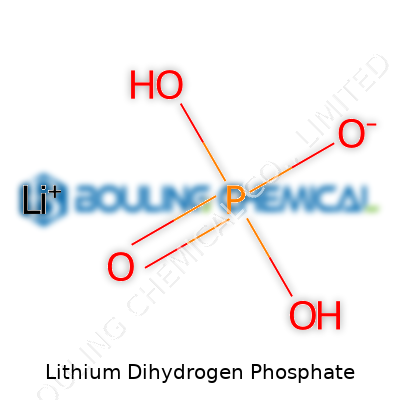
The world of chemistry turns on simple facts. Get the formula of a compound wrong, and mistakes begin to multiply down the line. Lithium dihydrogen phosphate brings together three elements that shape roads in both energy storage and fertilizers: lithium, hydrogen, and phosphorus. So, what’s its chemical make-up? The formula is LiH2PO4.
Lithium, known on the periodic table as Li, partners here with a dihydrogen phosphate group. That group looks like H2PO4- — a twist on the more familiar phosphate family. Toss in a lithium cation and you get a salt. No fancy alchemy, just the satisfying logic of charges balancing out.
Scientists don’t toss around formulas for fun. A clear chemical formula tells you how the compound behaves, what reactions it might enter, and where it might pack its punch. For instance, lithium dihydrogen phosphate interests battery researchers and fertilizer developers for different reasons, but they both lean on that reliable formula to keep things standardized.
My first brush with lithium dihydrogen phosphate came as a young lab assistant hunting for safer electrolyte salts in batteries. Researchers look for ways to balance safety with performance. Phosphates, including LiH2PO4, offer better thermal stability compared to the more explosive perchlorate or carbonate counterparts. They don’t catch fire easily. Every battery chemist worries about heat and runaway reactions, so a phosphate-based salt feels like a comfort blanket.
You also spot compounds like this in fertilizer recipes. The phosphate brings in phosphorus, crucial for root development in plants. Lithium’s role in plants isn’t well understood, but as a carrier, it can help get the phosphorus where it’s needed. Farmers want reliability: a fertilizer that breaks down at the right speed, doesn’t poison the soil, and delivers nutrients when crops need them most.
The challenges start with knowledge gaps. Anyone handling lithium or phosphates should know their risks. Lithium compounds can irritate the skin or cause environmental headaches if lots end up in groundwater. Phosphates, if overused, can trigger algae blooms that choke waterways. Regulators often step in to enforce boundaries, but the first check rests with the people using and selling these materials.
Education and transparency go furthest. Clear labeling, public databases on compound risks, and open access to research take guesswork out of chemical safety. Ignoring these steps lands us in trouble later—whether a warehouse fire or a river thick with weeds. Schools, universities, and businesses share the job of teaching science and responsibility side by side.
People can push for safer compounds and smarter practices. Lab managers can experiment with different sources to find lower-risk raw materials. Policy-makers can boost research into alternatives that hold onto performance and safety. Consumers and farmers alike can ask more questions about what’s in a fertilizer or a battery, tracing ingredients back to their source.
The formula, LiH2PO4, guides much more than just chemistry students. It centers a conversation about stewardship, transparency, and the direct line between the elements on a label and the quality of our food, energy, and environment.
Anyone working around chemicals knows there’s always risk baked into daily routines. Lithium dihydrogen phosphate rarely gets front-page attention, but skip the basics and it can punch above its weight in causing harm to people and equipment. Far too often, safety only gets real after something goes sideways. That’s too late. Good habits and straightforward understanding matter beyond what any form or checklist covers.
At first glance, lithium dihydrogen phosphate doesn’t sound menacing. It sits in battery labs, pops up in fertilizer mixes, and occasionally finds its way into specialty glass making. Its hazards come quietly, usually in the form of inhaled dust, accidental spills, or sloppy storage. Anyone who’s coughed their way through dust exposure quickly learns respiratory discomfort isn’t some theoretical concern. When powder gets in the air, face masks and eye protection make all the difference. Years of working around dry chemicals taught me: even those who scoff at “overkill” personal gear eventually come around, sometimes after a scare.
Safe handling starts with simple respect. Leaving sacks torn open, letting powder scatter near drains, or keeping it in a moist corner of the warehouse all ask for trouble. This compound reacts if mixed with strong oxidizers or acids, so staff must double-check storage—no improvising or stacking next to mismatched chemicals. A label may say “store cool and dry,” but anyone who's mopped up a spill on a humid day knows moisture’s quick to make clumps that stick to surfaces and tools. Regular training pays off most where people stay alert, know exactly where cleanup gear sits, and don’t short-cut the steps. It’s not about fear; it’s about keeping every day uneventful in the best way.
Over the years, I’ve seen even experienced hands make simple mistakes—eating near their workbench, skipping gloves on “just a quick bag change,” or brushing powder away without rinsing skin. Habits turn into discipline only if the culture supports it. Supervisors, not just safety officers, should actively talk through risk at the start of each shift. Hands-on demonstrations beat laminated memos every time. People look out for each other, and even newcomers feel safer if older staff welcome questions instead of rolling eyes. Nothing replaces a watchful buddy in a tight spot.
Good ventilation keeps dust down. Wet methods—using damp cloths rather than dry brooms—reduce airborne risk where powders get weighed or poured. Lockable, labeled bins cut down on “mystery white powder” moments and keep hands from wandering into danger. Disposable gloves and goggles are small investments compared to medical bills or lost work days. The Centers for Disease Control cites inhalation and skin contact as common routes for harm with inorganic salts like this one. Following basic, tested procedures keeps everyone’s lungs and skin safer over time.
Safety gains strength from the bottom up. Today’s minor shortcut becomes tomorrow’s incident report. Real safety grows out of respecting the materials in front of us. Lithium dihydrogen phosphate may not dominate news cycles, but everyone handling it deserves air that’s free to breathe and hands that stay clean. Culture shapes behavior; and behavior decides who goes home healthy at the end of the day.