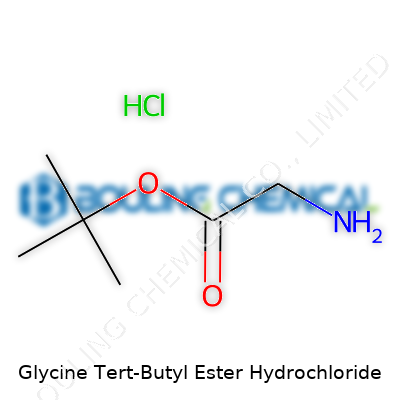
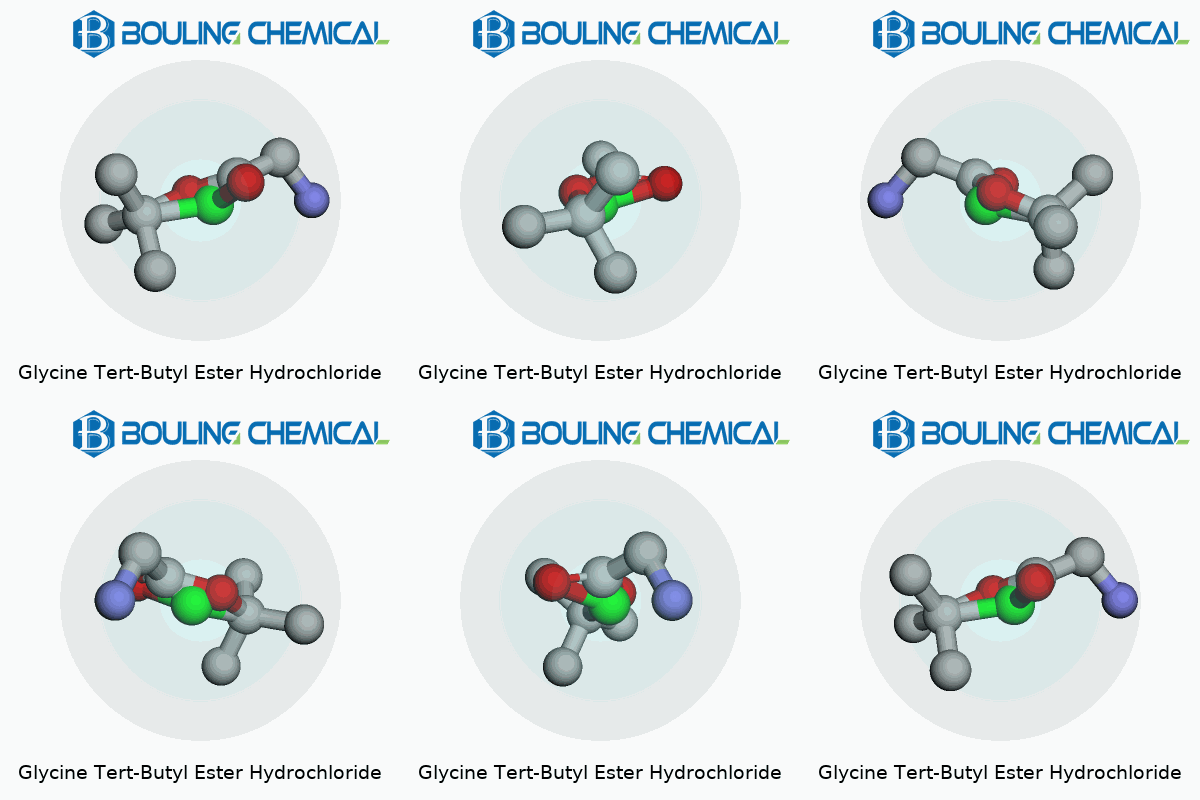
Back in the middle of the twentieth century, chemists began searching for efficient ways to protect amino acids during peptide synthesis. Industries and academic labs stumbled on glycine tert-butyl ester hydrochloride because plain glycine couldn't always cut it in multi-step processes. Protective groups like tert-butyl esters began taking off. Scientists were aiming for more reproducible chemistry. Peptide builders were tired of dealing with side reactions and low yields that plagued earlier approaches. So tert-butyl esters got adopted, offering acid-liable protection that made purification cleaner. Over time, the demand for more robust and predictable synthesis methods kept this chemical in the spotlight. Anyone tackling peptide fragments in the 1970s or early 1980s would've noticed a growing reliance on protected amino acids, and glycine tert-butyl ester hydrochloride became a quiet hero in that community.
Despite its mouthful of a name, glycine tert-butyl ester hydrochloride carries out a simple job. It gives chemists a form of glycine where the carboxyl end isn’t left exposed for unwanted reactions. With this, chemists can add glycine at a controlled position in a peptide, keep side reactions down, and later remove the tert-butyl group with acid to reveal the native structure. In practical terms, this means fewer purifications, higher yields, and more predictable results, especially in more complex synthesis work. It shows up as a white crystalline powder, stashes easily on a shelf, and gets thrown into reaction vessels in both academic labs and industrial plants worldwide.
Looking at the basics, glycine tert-butyl ester hydrochloride falls into the category of small organic molecules. It usually appears as an odorless white solid that dissolves well in polar solvents. The tert-butyl group, bulky compared to the parent glycine, builds in steric protection, keeping the reactive carboxylate protected until strong acid liberates it in a later step. With the hydrochloride salt form, the molecule handles more easily for both storage and use, as it resists hydrolysis under ambient conditions and doesn't draw much moisture from the air. The melting point lands high enough to ensure shelf stability, and solubility profiles fit right in with the workflow of standard peptide synthesis setups.
In day-to-day chemistry, purity means everything. Glycine tert-butyl ester hydrochloride usually shows up at over 98% purity, giving process chemists confidence batch after batch. Most chemical suppliers today base their quality control on chromatographic methods like HPLC and NMR analysis, ensuring the compound offers predictable reactivity and doesn't introduce rogue by-products. Companies also include batch numbers and lot data to track quality. Labeling lists the systematic name, common names, and hazard information as needed for safe storage and compliance with international standards, making inventory and regulatory checks straightforward.
The backbone of its synthesis takes advantage of classical esterification and salt formation. Chemists react glycine with tert-butyl alcohol in the presence of acid catalysts to form the tert-butyl ester, and then introduce hydrochloric acid to form the stable, crystalline hydrochloride salt. Many methods now avoid messy reagents and opt for controlled, scalable steps. Advances in solvent selection, reaction conditions, and purification have slashed costs and streamlined production, making this reagent more accessible to both small labs and production-scale outfits.
What sets glycine tert-butyl ester hydrochloride apart is its usefulness during the solid-phase peptide synthesis. The compound works by being selectively reactive. Its amino end can form peptide bonds, while the tert-butyl ester ensures the carboxyl group won’t participate until it's time. After it’s built into a sequence, the tert-butyl group drops off predictably with trifluoroacetic acid or similar acid treatment, restoring the free glycine residue. This “protect and deprotect” dance is central to modern peptide assembly, ensuring clean and sequence-specific coupling. The robust tert-butyl group resists most bases and neutral conditions, surviving other steps without incident.
Around the lab or in catalogs, glycine tert-butyl ester hydrochloride also answers to several names, trimming confusion in communication. Some refer to it as tert-butyl 2-aminoacetate hydrochloride, or occasionally as N-glycine tert-butyl ester HCl. Catalogs sometimes abbreviate the name, and chemists in a hurry might drop the “hydrochloride” when shorthand gossiping, though strict labeling always spells it out. This can mean double-checking bottles in shared spaces, but clarity helps prevent mistakes during runs.
Lab safety matters even for rather benign chemicals. The hydrochloride form reduces volatility, lessening dust or vapor concerns. Standard glove and eye protection seal the deal for day-to-day handling, and most chemical hygiene plans already address compounds of this type. After years spent in both academic and industrial labs, I've seen the value in clear signage and proper PPE compliance. Spills tend to clean up with simple dry transfer and ventilation, though ingestion or eyesplashes warrant a medical check. Training matters more than hazard level — people get complacent with “safe” chemicals, which can lead to small accidents. In regulated facilities, adherence to GHS (Globally Harmonized System) guidelines and good chemical hygiene protects both staff and product.
Peptide chemistry ranks as the clear stronghold for glycine tert-butyl ester hydrochloride. Medicinal chemists and biotech startups lean heavily on this tool to produce short peptides, research compounds, and small-molecule drugs. The versatility of the protected glycine unit gives researchers control over reactions, needed to make stepwise synthetic routes feasible in novel drug discovery. Academic research, process chemistry labs, and contract manufacturing plants all reach for this ester to meet their specific project goals. This application base keeps the demand steady, and I've seen no sign science is ready to give up on peptide-based therapies or tools.
Project after project pushes the boundaries of what this molecule can enable. Novel solid-phase synthetic protocols keep emerging, shaving time off previously laborious routes. Machine-based peptide synthesizers rely on reliable protected amino acids, and glycine tert-butyl ester hydrochloride stands as a backbone option for throughput and automation. R&D labs across the globe keep probing for ways to make peptide drugs more stable and to expand the set of amino acid modifications, spurring innovation in both process design and downstream molecular biology. On-the-ground scientists dive into optimization, refining yields, scaling up, and tuning protocols to make better medicines or probes.
Staying informed on the safety front means looking past MSDS sheets and digging into real toxicity data. Toxicology studies on similar tert-butyl esters mostly report low acute toxicity, but that doesn't mean risk-free chemical work. Longer-term exposure studies remain limited, demanding prudent handling. Institutional accident logs remind us even non-carcinogenic, non-mutagenic substances cause trouble if procedures get sloppy. Ingestion of hydrochloride salts generally brings gastric upset, reinforcing the need for good training on chemical hygiene. The biomedical research community often calls for more transparency and deeper studies when new analogs hit the market, because risk assessment depends on context and real-world exposures, something academic test tubes sometimes gloss over.
The horizon for glycine tert-butyl ester hydrochloride looks steady, if not expanding. Drug development pipelines increasingly tilt toward complex peptides and proteins, and every one of those starts with reliable building blocks. As automation takes deeper root and medicinal chemistry begins merging with data-driven optimization, robust intermediates like this ester will anchor workflows. Sustainability concerns will force the industry to rethink waste streams and solvent use, and some innovators already chip away at greener, safer production routes. As machine learning starts to influence process chemistry, demand for high-purity, traceable building blocks rises. Unless whole new paradigms for peptide assembly arise, this tert-butyl-protected glycine remains essential. After decades in the trenches, this is a case study in chemistry’s quiet facilitators — where incremental reliability, not flash, opens up new discovery.
Glycine tert-butyl ester hydrochloride has a name that trips up most folks, and yet it plays an understated role in scientific labs and research spaces. I remember seeing it on shelves during my early days helping with organic synthesis projects at the university. The bottle didn’t look special, but the work stemming from it changed the course of more than one research study.
At its core, this compound acts as a building block. It isn’t something you find in your kitchen, nor would you want to. Instead, it enters the scene for those working on peptide synthesis. In simple terms, peptides are short chains of amino acids—a step away from the proteins that make muscles, hormones, and enzymes. Chemists use glycine tert-butyl ester hydrochloride as a protected form of glycine, one of the simplest amino acids, to control how new molecules form.
Too often, early experiments in peptide chemistry ended with a mess of tangled molecules and unwanted byproducts. The tert-butyl ester group covers up part of the glycine molecule and acts like a temporary shield. It lets researchers stitch molecules together piece by piece, picking and choosing the order. If the world depended only on free glycine, research would be a slow and frustrating process with far too many false starts.
As years passed in the lab, I noticed this compound also found its way into other projects. Medicinal chemistry researchers picked it up to design new pharmaceuticals. By modifying the glycine backbone, they nudged molecules toward new shapes that might block a virus or slow a cancer cell. Every advance in this field followed years of trial and error, with building blocks like glycine tert-butyl ester hydrochloride as silent partners.
Sometimes, this chemical helps scientists make prodrugs—medicine precursors that activate only after entering the body. By using the tert-butyl group, chemists can tweak how fast or slow the drug breaks down. This means a medicine might last longer in the body or reach a difficult target tissue, like the brain. Without compounds like this, those kinds of innovations would stay out of reach.
Every useful tool in the lab brings trade-offs. Glycine tert-butyl ester hydrochloride can irritate skin and eyes, so it calls for solid training and careful handling. Proper ventilation, gloves, and patience matter as much as any beaker. Young researchers often learn this the hard way; I once dropped a vial during a long shift and spent the rest of the afternoon cleaning up and learning respect for safety protocols.
Chemists constantly look for better, safer ways to build and explore new molecules. Automation and digital record-keeping now track every use of compounds like glycine tert-butyl ester hydrochloride. New synthetic techniques aim to reduce waste and lower the risks of exposure. Experienced leaders teach the next generation to respect these building blocks not just for their chemical power, but for the history of hard work and discovery behind them.
Staring at a long chemical name like "Glycine Tert-Butyl Ester Hydrochloride," it’s natural to pause and ask what all those pieces actually represent. In labs and classrooms, folks tend to skip straight to facts, but the story of this compound’s makeup is more than a list of atoms. The molecular formula, C6H14ClNO2, puts everyday chemistry in plain sight: it’s about what happens when simple glycine morphs through a few smart swaps. Toss in a tert-butyl group (that bulky, carbon-heavy twist) and link it with a hydrochloride salt, and you get a fine-tuned building block many synthetic chemists rely on.
Glycine Tert-Butyl Ester Hydrochloride weighs in at about 183.64 g/mol—a number few remember unless they work with it often. Still, this simple figure shapes how researchers plan reactions, weigh batches, and handle storage. When you spend time in a lab, you learn quickly that wrong weights mean ruined experiments. Accurate molecular weights keep projects rolling smoothly, from early experiments up to scaled-up production.
Glycine itself sits at the root of peptide synthesis and plenty of research about the role of amino acids in biology. The tert-butyl ester doesn’t show up by accident. This modification keeps glycine from reacting in ways that get in the way of more complex chemistry. It’s like giving glycine a costume: the bulky group blocks the reactive parts chemists don’t want to use just yet. Add hydrochloride, and the compound dissolves more easily in certain setups, letting reactions move along with less fuss.
I remember struggles with amino acid protection strategies back in my university days, trying to keep the wrong parts from forming bonds when they weren’t supposed to. Simple chemistry tricks—changing a group here, shielding a site there—often save hours of troubleshooting. These protective esters, including the tert-butyl version, spare workers a lot of headaches by preventing messy mixes.
In peptide synthesis and drug development, accuracy matters. Every atom counts. Mess up the formula, overlook the chloride, or use the wrong ester, and lab work can drift off-track fast. This molecule matters because it makes some reactions possible that otherwise wouldn’t work, or wouldn’t work as smoothly. In biologics and pharmaceutical discovery, time matters and reagents like glycine tert-butyl ester hydrochloride help keep things efficient.
Every chemical toolbox comes with challenges. Some researchers wonder if there’s a safer, greener way to manage amino acid protection. Waste streams, solvent use, and reagent stability provide plenty for specialists to worry over. Newer "greener" protecting groups come up in discussion, but old standbys like the tert-butyl ester hang on because they work well and because the chemistry behind them is predictable and reliable. It’s up to labs, regulators, and industry experts to keep pushing for methods that protect workers, reduce waste, and get results that hold up to scrutiny.
Anyone who’s spent hours tracking down stray side reactions or troubleshooting yields knows the difference that careful chemistry makes. Glycine tert-butyl ester hydrochloride might seem like just another entry in a database, but it pairs practical chemistry with reliability. Understanding what’s behind those numbers—formula C6H14ClNO2, weight 183.64 g/mol—makes choices in the lab feel a lot less like guesswork, and a lot more like real progress.
Glycine Tert-Butyl Ester Hydrochloride doesn’t show up in most household cupboards, but lab techs, students, and life science researchers know it well. Charged with moving projects forward, no chemist wants to watch a pricey compound get wasted from careless shelf space or sloppy habits. I’ve watched plenty of good work stall out over a reagent gone bad just because details like humidity or daylight slipped through the cracks.
Water vapor, often underestimated, sneaks in and triggers all sorts of headaches, especially for hydrochloride salts. Legions of students learn fast that Glycine Tert-Butyl Ester Hydrochloride doesn’t forgive a cap left loose or a vial left open. Within weeks or even days, powder turns into an odd-looking clump, sometimes sticky and unusable. Chemical breakdown ruins purity, adds risk to your results, and easily costs money and time.
From my own time in shared labs, silica gel desiccators proved their worth again and again. Not every group gets fancy glove-box setups, but a sealed jar with fresh dessicant keeps air and moisture at bay. Even budget teams can stretch their supply dollars by storing this compound tightly closed, inside a moisture-proof container, tucked away from routine lab chaos.
People overlook how much direct sun and regular lighting cooks a chemical. Glycine Tert-Butyl Ester Hydrochloride doesn’t tolerate UV rays or brisk temperature shifts. I’ve seen bottles stored near windows fade or crust up, while others left by busy instruments soak up heat that degrades their contents faster. Simple changes make all the difference—good habits keep these compounds away from heat sources, out of sunlight, and in cool, steady places.
Standard refrigerators set to a few degrees above freezing often work well, though not every chemical wants the deep-freeze. With this one, keeping it somewhere cool but not below zero prevents condensation that sometimes forms when bottles warm back up. It’s about keeping temperature swings gentle, not extreme.
Nothing beats sharp eyes and clear records. Sharpies and date labels stop confusion, especially as stockpiles outlast their first users. A quarter-turn of a loose cap or a missing label can undo weeks of careful synthesis. If a powder cakes or clumps, that’s an early warning—time to swap it out before a failed reaction wastes more money and labor.
I learned early that it pays to set calendar reminders to rotate chemicals out and keep an updated log. It might feel like busywork, but one missed date can trigger a domino effect, causing more damage than a few minutes of organization ever would.
Lab shortcuts never pay off in the long run, especially for first-time students and junior researchers. Gloves, goggles, and quick cleanup after use keep both the person and the product safe. Even a spill or fingertip smudge can cause unexpected changes if left unchecked.
Responsible storage builds real lab confidence—colleagues soon trust each other's work more. Sharing best practices about storing chemicals like Glycine Tert-Butyl Ester Hydrochloride keeps bad habits from spreading and saves groups from costly mistakes down the line.
In any decent research lab, chemicals don’t just sit quietly in bottles. They create reactions, help synthesize targets, or provide starting points for bigger projects. Take glycine tert-butyl ester hydrochloride. To some, the name alone makes the eyes glaze over. But real chemical work doesn’t start until you know how and where a reagent dissolves.
I’ve sat through enough organic synthesis meetings to know this one crops up more than folks may expect. Quite a few researchers get stumped, often thinking tert-butyl esters should act tame in water because glycine, at its core, comes from the simplest amino acid. It’s tempting to figure it’ll dissolve just like salt. The reality takes a sharp turn.
Glycine tert-butyl ester bears a bulky tert-butyl group, which tacks on more hydrocarbon than a typical water-friendly compound carries. That’s the part that ruins a chemist’s hope for easy water solubility. The hydrochloride salt helps, but not as much as anyone wishes. In most practical settings, this ester shows poor solubility in water. Students sometimes get caught up in textbook logic and try water first, but end up with cloudy suspensions that refuse to clear.
Most experienced hands in academia swap water for organic solvents. Alcohols like methanol or ethanol do a far better job. Even more polar organic solvents, like DMSO, usually dissolve glycine tert-butyl ester hydrochloride with little complaint. I remember once spending hours shaking a flask, waiting for this compound to vanish in water — only to admit defeat and dump in some methanol, which solved the problem in minutes.
Cambridge Crystallographic Data Centre and supplier catalogs note solubility in these organic media but give warnings for water use. That’s not just a supply-chain footnote. In synthesis, solvent shapes purity, yield, and the safety profile for downstream reactions. Fumbling solvent choice wastes time and pushes budgets. For graduate students under pressure, chasing deadlines for thesis chapters and paper submissions, choosing the right solvent can mean the difference between another late-night lab session and getting actual sleep.
Getting solubility right impacts every step forward. Poor dissolution in water means trying to use aqueous routes for synthesis or purification rarely pans out. Instead, chemists turn to dry reactions or organic medium-based steps. This changes how to handle waste, since organic solvents come with extra care for emission and disposal rules. Waste collection gets bulkier, procedures pivot around fire risks, and cleanup takes longer. Budget lines for solvents take a hit faster than anyone likes.
On a larger scale, this choice touches regulatory work, especially for drug manufacturing or scale-up processes. If a process depends on organic solvents, cost and environmental burdens climb. In my own time consulting, more than one biotech group has learned the pain of switching from water-based to organic routes only after investing in equipment or hiring staff trained for water-based chemistry.
Better solvent blends exist. Some teams use co-solvents, adding a splash of ethanol or isopropanol to water. This can nudge dissolved amounts higher without relying fully on organics, lessening environmental loading. Techniques like ultrasonic agitation or gentle heating also improve dissolution, cutting wasted materials and accelerating reaction times.
Decisions about solvents stretch beyond the bench. The unexpected struggle to dissolve glycine tert-butyl ester hydrochloride in water stands as a reminder that textbook chemistry and real-world constraints never completely align. With careful planning and smart solvent choices, science inches forward, one solution at a time.
Working in a research lab, every chemical tells its story. Some seem benign until carelessness stacks up into real trouble. Glycine tert-butyl ester hydrochloride, common in organic synthesis, offers plenty of utility but demands sharp attention to safety. I learned early on: skipping steps risks more than productivity; it can impact personal and team health.
The first splash of any hydrochloride salt across a glove or sleeve forces a pause. Direct contact with glycine tert-butyl ester hydrochloride can trigger irritation—more severe with the eyes. Protective gloves and goggles are not optional extras in these settings. The chemical may not eat through nitrile in seconds, but over time even the sturdiest gloves can let something through. Regularly swapping out disposable gloves, keeping goggles tight, and facing spills as potential incidents guard against weekly interruptions and long-term health issues. I’ve seen colleagues regret loose discipline—reddened eyes, itches on arms, delays from medical checks.
Opening a bottle in a closed room leaves subtle clues in the air. It’s easy to think nothing harmful escapes, but dust and vapors stack up. Chronic low-level exposure invites respiratory discomfort and raises risks science journals warn about. Any procedure involving this hydrochloride fits best beneath a fume hood. The difference isn't only regulatory—it’s about comfort and trust among lab mates. The hiss of the ventilation system means air stays clear, and every breath carries less worry.
Shelf stability often turns into a guessing game when compounds attract moisture or break down over time. This ester salt draws water from air and can degrade if left in an open container. Best practice means sealing containers snugly after every use and storing in a dry, cool spot. Powders like this sneak past loose caps, so containers built for chemicals—airtight lids designed for labs—become as important as the chemical’s label.
Minor spills happen, but the aftermath reflects experience. Small amounts call for immediate cleanup using absorbent paper and approved disposal bins. Larger spills should bring out spill kits—neutralizing agents, dustpans, and prepared personnel. During my graduate days, delayed response resulted in residue eating into bench finishes and fouling shared equipment. Spills left unreported eroded trust among lab members. The message spread: clean first, ask questions after—transparency helps everyone avoid costly or dangerous repeat mistakes.
Reading labels helps, but hands-on training speaks louder. Regular refreshers on chemical handling techniques set the stage for safer workplaces. New faces in the lab benefit most when senior researchers share habits and cautionary tales. I was spared a nasty incident when a mentor pointed out how to tilt a container away from the body, reducing splash risk and tightening procedures one simple trick at a time.
Safety doesn’t grow out of fear—it grows out of respect. Standard equipment, clear storage plans, good ventilation, timely response to accidents, and continual education shape a culture with fewer injuries and better science. With compounds like glycine tert-butyl ester hydrochloride, every action reflects a shared intent: finish the day with health and confidence intact.