Years back, chemists searching for ways to boost lithium-ion battery performance hit a wall with electrolyte additives. Solvents broke down, metal dissolved, and batteries wore out too fast. Lithium difluorophosphate started out as just another speculative salt, but research in labs across Asia, Europe, and America kept bringing it up for its knack at extending battery lifetimes and reducing failures. The 2010s saw a push for safer, longer-lasting batteries to power electric cars and back up growing solar farms. Between government grants and battery startups clamoring for the next big thing, teams raced to understand new salts. Lithium difluorophosphate emerged, not because it was perfect right away, but because it offered a smarter path past the regular breakdown mechanisms. Its story mirrors the general shift to more sophisticated additives with a heavier emphasis on real-world battery stress tests instead of just raw lab data.
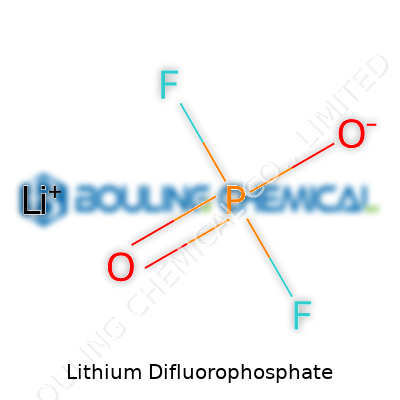
Folks in the battery world talk about lithium difluorophosphate as an electrolyte additive or main salt for high-performance lithium cells. In plain talk, this chemical aims to help batteries last longer, deal with higher voltages, and stay safer under abuse. It comes as a white, mostly odorless powder—looks plain, but its effect runs deep once dissolved in a mixture with other lithium salts and solvents. The chemical structure, featuring two fluorine atoms with a phosphate backbone hooked to lithium, gives it an edge for forming protective films on both cathodes and anodes. Labs learned the hard way that metallic lithium needs a thick skin to avoid trouble; this salt helps because its breakdown products knit together tight, stable coatings on battery internals. Companies sell it under varied trade names and abbreviations, but the backbone remains the same.
This salt goes by the shorthand LiPO2F2. In practice, manufacturers note it dissolves well in most carbonate solvents, which already serve as the base for today’s lithium cell electrolytes. Chemically, its charm stems from higher oxidation stability compared to legacy options like LiPF6 or LiBF4. Where older salts fall apart under heat or voltage, lithium difluorophosphate hangs on, splitting into predictable fragments that do less harm inside a cell. Its melting point sits above typical room temperatures. Industrial labs pay close attention to purity and moisture content—water contamination spells disaster, causing gas evolution and breakdown. Packaging has to keep it bone dry, and experienced chemists use gloveboxes just to handle the stuff.
In terms of bench chemistry, lithium difluorophosphate stands out for reliably delivering specific ionic conductivities when mixed at careful concentrations, typically measured in molarity. Electrolyte blends often feature this salt in amounts that reach a sweet spot: enough to do its protective work, not so much that it lowers overall conductivity or jacks up viscosity. Standard packages include everything from grams for academic labs to multi-ton batches for cell factories. Labels on drums focus on purity (often above 98 percent), main trace metal contaminants, water content (measured in parts per million), and safety phrases for storage and handling. For research-grade material, HPLC and NMR data help scientists verify composition before use.
Synthesizing lithium difluorophosphate stays off the front page, but folks with chemistry backgrounds know its production draws from classic phosphorus chemistry married to high-purity fluorine sources. Typical routes—at a glance—involve mixing lithium carbonate or lithium hydroxide with phosphoryl difluoride compounds under controlled moisture and temperature. The steps often generate hazardous byproducts, so only trained teams handle scale-up safely. Careful distillation, crystallization, and drying make for a fine, stable powder fit for battery-grade needs. The prep side remains a quiet arms race: companies tweak details to minimize cost, boost yield, and stave off trace impurities that would haunt battery performance down the line.
Inside a battery, lithium difluorophosphate doesn’t just sit idle. Electric current and high voltages nudge it to break apart, releasing reactive fragments that interact with both positive and negative electrodes. The fragments take part in building solid-electrolyte interphase (SEI) layers, especially on graphite anodes and nickel-rich cathodes. These microscopic coatings determine how well a battery can charge, how long it’ll last, and how safe it stays when pushed. Scientists constantly test ways to blend this salt with other additives, hoping to fine-tune how the SEI forms to keep metal ions from dissolving or keep gas from evolving at high voltage. Some labs are tinkering with custom fluorinated phosphate molecules, hoping to keep all the good and reduce the leftover baggage.
In laboratory journals, this salt’s name crops up as lithium difluorophosphate, lithium bis(fluoro)phosphate, or just LiPO2F2. On product sheets, vendors might list a brand name—details vary, but chemists always double-check the structural formula before adding any new chemical to a sensitive battery blend. The naming trail sometimes muddies the waters, especially for researchers translating technical papers from Chinese, Japanese, or German sources.
Working with lithium difluorophosphate means strict safety routines at every step. The salt reacts aggressively with moisture and should stay sealed in inert gas until dissolved in dry solvent. Direct skin and eye contact can cause irritation, and inhaling dust cannot be taken lightly. Factory environments rely on gloveboxes and vented hoods. Storage stays in robust, government-certified drums lined with moisture-proof liners. Spills get cleaned up fast with inert absorbents, not water. Process engineers monitor air and surfaces for stray salt, and safety data sheets stress the danger of mixing this material with acids or strong bases. Employees don goggles, gloves, and sometimes full-face protection, especially during transfer or blending. Regular safety drills and real-world practice reduce the odds of accidental release or exposure.
Lithium difluorophosphate earns its paycheck mainly as a star electrolyte additive for advanced lithium-ion and lithium metal batteries. Top research points to its edge in high-voltage cells and fast-charging designs, where other salts fumble or degrade. Its benefits show up in electric vehicles, grid storage packs, and consumer gadgets that struggle with heat, high output, or both. Solid-state battery ambitions also draw on this salt’s ability to stabilize tricky interfaces. Research teams keep chasing ways to stretch battery lifetimes, push up charge speeds, and run cells at higher voltages without gas and swelling. Adding lithium difluorophosphate often gives a few extra percentage points of longevity or safety—not a small win, considering the risks of battery fires or warranty claims.
A flood of published papers and patents tracks the surge in R&D for lithium difluorophosphate. State-funded labs conduct cycle testing and post-mortem analysis on cells built with this salt, looking for clues about failure modes at every scale. Universities dive deep into surface chemistry, using high-powered microscopes and spectroscopy to map how SEI layers evolve over hundreds or thousands of cycles. Meanwhile, battery OEMs privately test custom formulations and benchmark rivals. International conferences buzz with talk of next-generation cathodes and the clever electrolyte blends that support them. Every year sees fresh debates: how to tune concentration, which co-additives deliver better shelf life, and how to manage long-term effects from chemical byproducts trapped in battery guts.
Safety demands extend beyond the plant walls—people want to know what happens if this chemical escapes into soil, water, or air. Toxicology experiments test how lithium difluorophosphate affects rats, fish, and simple cell cultures. Results show it acts as an irritant and calls for careful handling, but not every hazard reaches the level of some legacy salts or solvents. Regulators review animal studies to set workplace exposure limits, while environmental chemists study decay pathways in natural conditions. The hunt continues for safer, greener chemicals. No company wants to risk a cleanup bill, brand damage, or health lawsuit.
Today’s battery world gets more complicated all the time—electric vehicles grow more popular and renewable energy hinges on roomier, more resilient energy storage. Lithium difluorophosphate holds promise for staying in the mix, especially as engineers push battery voltages higher and cycle counts longer. Research may steer its use toward all-solid-state batteries, semi-solid designs, and hybrid approaches merging old-school anodes with advanced cathode coatings. Market demand will drive scale-up and cost drops, but labs will keep chasing side reactions and longer-term safety questions. Lessons learned from this salt will shape policy and industry standards for a generation of batteries built for safety, speed, and tougher environments.
A battery isn’t just a black box stuffed with generic chemicals. In the world of lithium-ion batteries, each additive plays its own part in managing safety, performance, and even how long your battery can last before it fizzles out. Buried among all these helpers is lithium difluorophosphate. The name isn’t catchy, but don’t let that fool you. This compound brings more to the table than most people realize, and we'd see a slower road to cleaner cars without it.
Anyone who’s left a smartphone out in extreme heat or cold knows batteries don’t always cooperate with the real world. Electric vehicles make this problem bigger. Getting a car to run on electricity out in winter or under a blazing sun throws plenty of curveballs at battery makers. To keep batteries safe and reliable, chemists have leaned on lithium difluorophosphate as a secret weapon.
From experience talking to battery engineers and reading up on cell failures, one fact keeps popping up: batteries tend to get cranky as they age. Unstable reactions can create gas or even catch fire. Lithium difluorophosphate goes into the battery’s electrolyte to act as a supportive bodyguard. It forms a thin layer on the electrodes, helping keep nasty reactions from ever starting in the first place. The car doesn’t go up in flames, the battery runs longer, and the headaches for everyone involved drop by a notch.
Most users expect their car or laptop to last for years without losing too much power. For that to work, the inner chemistry has to resist all the slow damage from everyday charging and discharging. Research shows that lithium difluorophosphate doesn’t just block reactions; it also helps these batteries hang onto their juice better over time. It plays a role in making the separator—an important part inside the cell—more durable and less vulnerable to breakdown. In my own visits to labs, technicians have pointed out that this means fewer dead battery cells and less wasted material.
Automakers are wrestling to build batteries that last through a decade of commutes. With lithium difluorophosphate as part of the mix, they see better cycle life and less capacity loss as the clock ticks.
No ingredient comes cheap or without its own problems. As battery production races forward, the pressure builds to create enough lithium difluorophosphate safely and efficiently. Workers in the battery supply chain worry about having enough of these specialty chemicals, especially if electric cars keep seeing soaring demand. From a policy and engineering point of view, this means more research into recycling and alternative additives that could fill in, just in case there’s a bottleneck.
Startups are already exploring how to recover these niche chemicals from spent batteries, and there’s a push for greener ways to make them in the first place. If that pans out, the industry could shrink its environmental footprint and avoid shortages that would hit the new wave of electric cars.
Electric cars won’t see their moment in the sun without safer, more reliable batteries. Lithium difluorophosphate is playing its part to get us there faster. By keeping batteries in working order under stress and helping keep safety incidents at bay, this behind-the-scenes chemical has found its place in the modern energy story. Not many people outside laboratories will recognize its name, but people feeling confident plugging in their vehicles have it to thank, at least in part.
Plenty of talk around next-generation batteries focuses on the hunt for safer, more efficient electrolytes. In this conversation, lithium difluorophosphate comes up more and more often, especially in labs and R&D circles. Its chemical formula, LiPO2F2, holds a remarkable story about the direction energy storage might take in the coming years.
Lithium-ion batteries power much of our world, from phones to electric vehicles. But the safety of these batteries, especially as they operate under pressure—colder winters, summer heatwaves, higher voltages—depends heavily on their component chemicals. The liquid electrolytes inside them move lithium ions from one electrode to another. Standard salts like LiPF6 get the job done, but researchers have run into problems. Moisture can break them down, which releases toxic compounds and eats away at battery life. So, new options like LiPO2F2 seem promising. This lithium salt brings both phosphate and fluoride to the formula, giving it a solid mix of stability and conductivity.
The chemistry world often gets sweeping when describing a compound’s value. From my perspective, it’s about trust—trusting that plugging in your EV won’t mean a fire risk or a shorter charging cycle each year. Battery researchers say that LiPO2F2 can help form a more stable protective layer on battery electrodes, fending off internal decay. It’s not just about chemistry. It’s about peace of mind for everyone who depends on electronics lasting all day.
I’ve seen teams in university labs push lithium salts to their limits. Many early electrolytes fizzled out when cycled at high voltages—or worse, failed to prevent those dendrite “trees” that can short-circuit cells. Lithium difluorophosphate often stands up better in these tests, thanks to its chemistry. The phosphate backbone resists breakdown from water, while the fluorine atoms help build that tight protective film on the anode. This means batteries can take more charge-discharge cycles before losing performance. That matters in real life, where nobody wants to replace a device or car after a short time.
There’s a bigger conversation happening too. Every compound in a battery travels a path from factory to recycling bin. A less stable electrolyte can mean more industrial hazards and waste. The hope is that LiPO2F2 can ease some of those pains by reducing the need for additives and lessening side reactions that age batteries too quickly. Chinese research groups and US start-ups have both published on these benefits, with many noting improved cycle life and lower risk of battery swelling or venting.
Plenty of hard work still lies ahead. Scaling production cost-effectively and ensuring compatibility with the latest silicon or graphite anodes stays at the front of the pack. As the pressure for longer range and faster charging grows, every piece of the chemical puzzle matters. Lithium difluorophosphate, with its carefully engineered LiPO2F2 formula, seems set to earn a place in that puzzle, building a foundation for safer, longer-lasting and more reliable batteries.
Lithium difluorophosphate, or LiPO2F2, isn’t a household name. It’s a compound playing a minor but growing role in battery technology, especially the kind of high-energy batteries powering electric cars and gadgets. If you work in labs or factories testing new battery chemistries, hearing about new lithium salts like this one goes with the territory.
A lot of attention falls on lithium compounds because of their reactivity. Lithium quickly reacts with water, and any compound featuring fluorine usually signals risk of toxic gas formation. LiPO2F2 joins that trend. If it comes in contact with moisture, hydrolysis kicks in, releasing corrosive substances like hydrogen fluoride. I remember one year in a basic chemistry class when a few drops of concentrated hydrofluoric acid ate through a glove in minutes—a stark warning to never get too casual around fluorine chemistry.
It’s not just skin-deep risks. Breathing in even tiny amounts of some lithium or fluorine-containing dusts or vapors causes trouble for the lungs and mouth. Long-term exposure to these kinds of chemicals in poorly ventilated spaces isn’t just a regulatory red flag—it's a real health issue. The news may focus on splashy battery breakthroughs, but the workers blending and testing these powders face eye, skin, and respiratory risks every day.
Handling lithium difluorophosphate means keeping dry conditions front of mind. It isn’t a material you scoop with bare hands, not even for a moment. In research spaces, people put on nitrile gloves, safety glasses, and lab coats. Any spill requires a proper cleanup with equipment rated for irritating and toxic dust, usually with a decent HEPA vacuum and not a regular broom or rag. Only people trained on chemical compatibility guide the process. There’s a reason for this: a brief mistake can cause burns, or worse, expose someone to harmful fumes.
People sometimes think newer battery additives might be less dangerous just because technology moves forward. In reality, every new lithium salt brings its own risks and quirks. Companies that cut corners or don’t offer full training invite accidents. There are stories in academic labs and startups of burns or ruined experiments—some public, others quietly fixed behind the scenes.
Safety data for lithium difluorophosphate tells a clear story—this stuff belongs only in the hands of trained professionals in sealed, ventilated, and dry spaces. Relying on gloves, goggles, and fume cupboards isn’t optional. Washing your hands before eating, not carrying your phone into the glovebox, even using silicon grease to keep glovebox seals in top shape—these seem basic, but they make all the difference.
I’ve seen people get too comfortable, skipping detailed training because they "already know lithium." The best labs require regular refreshers, invest in good ventilation, and have emergency routines drilled into everyone. Trust gets built through seeing leadership enforce real safety, not just adding a poster to the wall.
As battery research keeps speeding ahead, more workers and students come into contact with compounds like lithium difluorophosphate. Building a culture where no one gets lazy about personal protective equipment—where people know the why behind each rule—matters more than any single piece of gear. Sharing lessons from mistakes, and staying up to date with new safety findings as these materials evolve, will always be better than pretending every lithium salt acts the same. If there’s an easy fix, it’s pushing for training, better gear, and giving people the right to ask questions before handling anything unfamiliar.
Lithium difluorophosphate stands out in the battery industry, and not just as a buzzword for researchers chasing higher performance. It gets used for a reason: it delivers actual improvements in lithium-ion electrolytes, especially in high-voltage and fast-charging applications. But everybody working in a lab or production line knows that what makes a material effective in a cell can also make it a headache to store safely. I’ve seen how easily good intentions give way to costly mistakes, especially if basic storage rules get ignored.
The main challenge with lithium difluorophosphate boils down to its strong reactivity with moisture. Even low levels of humidity can trigger decomposition. Water vapor in the air breaks it down, causing it to release toxic gases such as hydrogen fluoride. That’s not something you want to happen in your storage room—or worse, your lab. If you crack open a container that’s soaked up moisture, the trouble starts fast and never ends well. Skin contact can lead to burns, and breathing in fumes becomes a real health risk.
The right way to store lithium difluorophosphate focuses on two things: keeping air and water away. In practice, that means using airtight containers, usually made from materials like PTFE or glass. Plastic bags just don’t cut it; the chemical will eat through ordinary plastic or leach moisture straight through it. Most labs put these containers inside glove boxes filled with dry argon or nitrogen gas. Some opt for dedicated desiccators loaded with fresh desiccant. It’s not about chasing fancy tools—it’s about adopting basic habits that keep everyone safe and keep your investment from turning into hazardous waste. I’ve watched people lose expensive batches just because someone skipped double-sealing or ignored that the glove box’s humidity alarm was beeping.
Heat speeds up unwanted reactions. While lithium difluorophosphate doesn’t combust at room temperature, higher storage temperatures make it degrade faster. Most best practices recommend storing it cool—somewhere between 2°C to 8°C, like inside a well-marked refrigerator used only for chemical storage. Ultraviolet light also kickstarts breakdown, so the containers need to be kept well away from direct sunlight or strong indoor lighting. Every seasoned chemist knows the value of simple things like a covered cabinet or an opaque secondary jar. In my time setting up small R&D labs, small steps like lining a shelf with foil have spared us from expensive mishaps.
All this sounds straightforward, but it fails fast if people aren’t properly trained. Proper labeling, ongoing training, and clear written procedures go further than any costly gadget. I’ve worked alongside teams who put peer checks in place—just a quick sign-off before returning material to storage. Problems don’t sneak up when everyone is reminded what’s at stake. This isn’t just about protecting the chemical; it’s about the people handling it, the quality of research, and the bottom line.
There’s growing interest in finding more stable alternatives, but until then, better awareness and training remain the best line of defense. Engineers and chemists alike could benefit from sharing simple case studies—a quick story about what went wrong and what fixed it. Vendors can do their part by including clear, bold instructions on every shipment. In labs, centralizing storage of sensitive materials cuts confusion and helps people look after critical assets together. Safety isn’t just regulatory red tape—it’s the difference between progress and costly setbacks. Real-world experience proves that the right storage methods aren’t complicated, just necessary.
Few people spend their mornings thinking about battery chemistry, yet most folks get annoyed when their phone dies too soon or their electric car charges slowly. After using gadgets and rechargeable tools for years, I have noticed many promises of “next-generation” batteries, only to see another charger go missing or a battery degrade after too many cycles. Change moves slowly, but sometimes a technical tweak can make life a little easier for all of us. Lithium difluorophosphate (LiPO2F2) is one of those small but significant chemicals that’s helping batteries handle the growing demands of modern devices.
The key job of lithium difluorophosphate is not flashy, but it’s critical. This compound gets added to the liquid inside lithium-ion batteries. Its main role is protecting the battery’s vital parts, especially during charging and discharging. LiPO2F2 produces a thin but robust layer on the electrodes, blocking unwanted reactions between the liquid electrolyte and the materials that store energy. Fewer side reactions mean less damage over time, so batteries keep working longer and charge more efficiently.
From my own experience with laptops and e-bikes, battery life often drops off much faster in hot or cold environments. That’s not just a nuisance—it hits reliability, which matters for people depending on their device for school, work, or travel. Lithium difluorophosphate stands out for its ability to keep those protective layers stable even at higher voltages and wider temperature ranges. Under the hood, good chemistry equals longer daily range on an e-bike and fewer battery replacements for the latest gadgets.
Safety has to come first. Overheating batteries make headlines for the wrong reasons. LiPO2F2 improves the stability of the electrolyte, cutting the risk of harmful gas generation and helping prevent short circuits that might trigger fires. Studies have shown that batteries treated with this additive keep their shape and avoid swelling or rupture under stress conditions. For anyone who remembers old laptops bulging or a phone feeling too hot, this change gives some peace of mind.
A friend of mine recycles batteries for his job, and I’ve learned secondhand just how much waste piles up from batteries that fail too soon. Consumers now expect sustainable solutions, and companies get pressured to use fewer rare metals and cut down on e-waste. Lithium difluorophosphate helps extend each battery’s working life, so fewer cells end up in the waste stream. Plus, energy efficiency rises with each improvement—meaning less electricity gets wasted while charging, so those who worry about carbon footprints get a little relief too.
Researchers keep exploring how much further this additive can go, especially alongside new battery designs and greener materials. Collaboration between universities and industry pushes these advances into commercial products faster. From experience, breakthroughs don’t always come from headline-grabbing inventions—a well-timed improvement to a proven technology can reach millions of people quickly. Lithium difluorophosphate may not sound glamorous, but every layer of battery protection helps us build devices that last, stay safe, and work longer between charges.