Interest in carbon tetrafluoride started to gain traction during the early twentieth century. Researchers sought stable inert gases for electrical insulation and coolants, looking for something resistant to chemical attacks and breakdown at high voltages. CF4, as many chemists know it, started as a laboratory curiosity but soon emerged as a critical gas for plasma etching in semiconductor manufacturing. Decades ago, its ability to avoid reactivity with most materials made it a quiet favorite where corrosive atmospheres would destroy less stubborn molecules. Watching how a gas with no color or odor became vital for making microchips shows just how fast technology bends basic chemistry for giant leaps in capability. Even with new materials flooding the market, CF4 has persisted—a testament to both the vision of early fluorine chemists and the reality that some chemical properties stay unmatched.
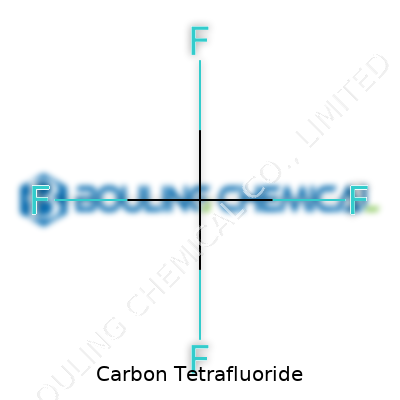
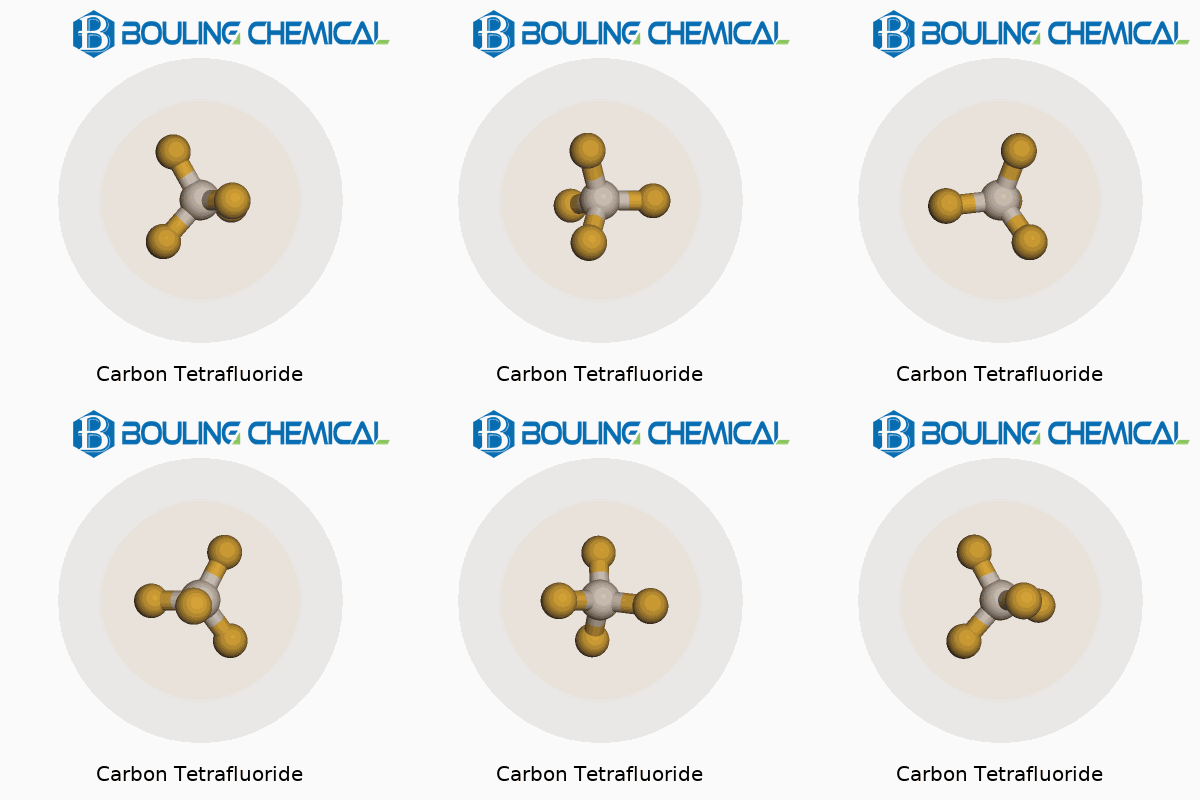
Carbon tetrafluoride, more often called tetrafluoromethane in industry, remains a simple carbon center surrounded by four fluorines. What appears as an innocuous gas at room conditions forms the backbone for countless etching processes across the globe. In my own experience working around cleanroom environments, tanks of CF4 are a regular sight. Chip fabs, solar panel plants, and certain refrigeration applications use this gas to do jobs no other does quite as cleanly. Handling and storing it doesn’t require extraordinary containment—regular compressed gas techniques work well. Its stability under pressure and non-corrosive nature to most vessel materials make it easy to transport and store, though safety standards are never relaxed.
Gaseous at standard conditions, carbon tetrafluoride registers almost no color, taste, or smell—simple, undetectable to the senses. Boiling at roughly -128°C, it hangs around as a gas in nearly every environment besides deep freeze. It doesn’t dissolve much in water, so spillage means it floats away rather than lingering. Chemically, it tends toward remarkable stability. For most people familiar with fluorocarbons, this is no surprise—C–F bonds demand enormous energy to break. This characteristic gives CF4 its value in industry: it shrugs off most acids, bases, and oxidizers, only reacting under energetic plasmas or flames. That same feature makes it persistent; once released, it lingers in the atmosphere for tens of thousands of years, making thoughtful management more urgent.
Bottles leave factories stamped with hazard warnings, contents, and purity information, following rules set by agencies like OSHA or ISO. Designers in semiconductor lines call for high-purity product—trace contaminants throw off etching patterns and leave behind residues that can destroy entire runs. Purity levels easily run past 99.99% for these uses. Lower grades, more flexible, show up elsewhere, such as refrigeration, where tiny impurities aren’t as destructive. Labels explain hazard classes—nonflammable, asphyxiant at high concentrations, and an environmental warning pointing to its greenhouse gas status. You quickly learn that every cylinder on-site has to have traceability to the lab report: nobody wants a process halted for stray impurity or regulatory misstep.
Old-school synthesis started with inflating carbon powder with fluorine at high temperatures—a risky operation, given fluorine’s notoriety for explosive results. Modern plants tend to lean on more controlled methods, such as the reaction of carbon monoxide and fluorine over catalysts or, more rarely, hydrofluoric acid replacements paired with halogen sources. Efficiency and operator safety have improved, especially since fluorine-handling techniques matured. Engineers focus on closed-system reactions where few byproducts arise, since venting unreacted fluorine or excess carbon monoxide isn’t one of today’s accepted practices. Years back, a friend who worked at a gas supplier recalled the nerves during early attempts to scale up—every leak meant hazardous gas, and every inefficiency translated to sky-high costs. Years of process improvement turned this gamble into a repeatable routine.
Most chemicals put in the same room as CF4 get ignored. Its reluctance to react is a hallmark—on a bench it simply doesn’t do much unless coaxed with strong radiation, electrical discharge, or extreme temperatures. Under plasma, though, it comes alive: those stable C–F bonds crack open to generate reactive fluorine atoms. That’s the very tool semiconductor etchers need, letting them carve precise lines into silicon or clean reactor walls with surgical precision. Trying to modify CF4 directly into other molecules takes so much energy as to be uncommon. More often, it’s consumed as a feedstock for specific fluorinated compounds, but only with great effort and rarely outside major facilities.
Names depend on who’s talking. Chemists stick to tetrafluoromethane or carbon tetrafluoride. Semiconductor crews call it CF four. Catalogs list it under R-14 for refrigeration circles, though that use is less common than before. Safety posters stick with the formula. These varied names wind up on bottles, datasheets, and safety protocols, but everyone working with it recognizes the telltale chemical formula, which carries more authority than any brand name or industry label.
Moving and using carbon tetrafluoride goes smooth when standard gas-handling rules are followed, but operators need to pay attention to ventilation and focus on asphyxiation risks. Despite claims of being inert, it won’t support life, and a leak in a closed room can push oxygen levels down dangerously fast. Adding automatic leak detectors and alarms is more than just a compliance box—people have suffered in rooms filled with odorless, colorless gases before realizing it. Besides, regulatory pressure around its climate impact means plant runners stay vigilant for any emissions or accidental releases. Over the years, training has shifted from basic chemical safety to real-time monitoring for leaks and fast response plans. Safety audits grow more frequent, not out of bureaucracy, but because even minor spills carry outsized consequences.
Etching in chip manufacturing is hands-down the headline use. Every smartphone, server, or car built today likely traces some features made possible by CF4 plasma. Its cutting ability delivers crisp, narrow lines essential as devices shrink. Cleanrooms rely on it for chamber cleaning too, blasting away residue that slows output or spoils sensitive electronics. Refrigeration once counted on CF4 as an “R-14” coolant, though environmental regulations and better options have cut into this slice of the market. Sometimes, specialty lasers and certain military applications also turn to this molecule, leaning on its breakdown to generate reactive fluorine atoms in controlled settings. Each of these uses treats carbon tetrafluoride less as a commodity and more as a precision tool, tailored for modern manufacturing’s tight tolerance.
Labs keep searching for ways to stretch or replace what CF4 brings. Environmental pressures nudge researchers to find alternatives with lower atmospheric lifespans and less warming potential. Fundamental chemists still study its electronic behavior—how does such a simple molecule fend off all comers and refuse to break down except under extreme circumstances? Engineers tinker with plasma tuning, trying to pull out the exact etching profiles needed as transistor sizes shrink beyond imagination. Every leap in fabrication pushes CF4’s performance to new edges, prompting questions about process improvements or entirely different gases. Some experiments test recover-and-recycle schemes, hoping to recapture spent gas for reuse and reduce environmental tolls. Direct substitutes remain elusive; nothing beats its blend of stability, volatility, and action under plasma at the scales modern fabs demand.
Toxicologists give CF4 a relatively “safe” bill compared to more reactive fluorocarbons, but nobody considers it risk-free. Long-term exposure data remains slim; asphyxiation is the immediate hazard, but finer effects on breathing and health over years of low-level leaks or chronic plant exposure aren’t fully mapped. Toxicity studies focus more on acute exposure—what happens during a cylinder rupture or bad accident—than on minute-by-minute drifts in open air. Environmental scientists sound alarms for its climate impact. With a global warming potential far beyond CO2 and an atmospheric lifetime stretching tens of thousands of years, CF4 stands nearly alone for persistence. Releases today last into the far future, cementing the urgency for leakproof designs and ambitious containment.
Tougher climate rules look set to reshape how manufacturers view, use, and handle carbon tetrafluoride. The search for alternatives won’t slow, especially as governments start capping emissions and charging for each ton released. Recycled gas streams and plasma processes tweaked for efficiency could check some of the climate cost, but demand for ultrapure etchants remains stubborn. Any new alternatives must match or beat CF4 on reliability, availability, and end-product quality—no small ask considering its historic staying power. Tech firms and environmentalists now sit across the table, both recognizing that new chipmaking breakthroughs mean precious little if they leave behind an atmospheric legacy. The smartest move is clear: smarter containment, closed-loop processes wherever possible, and continued push for gases that only do their jobs, then vanish or break down instead of lingering for generations. Watching science contend with such legacy chemicals, there's a sense the next decades will see as much progress in responsible management as in outright replacement.
Whenever someone brings up carbon tetrafluoride, you probably don’t think about it for long—unless you build electronics or follow climate science. CF4, as those in the industry call it, isn’t a household name like carbon dioxide. Still, it plays a quiet, but key role in things most people use daily, such as smartphones, computers, and solar panels.
Silicon wafers don’t start out as the clean, patterned slices you see in tech articles. Manufacturing plants use CF4 as a plasma etching agent. Its ability to help carve out intricate designs helps make the guts of electronic devices smaller, faster, and more energy-efficient. Watching a plasma etching demo in person, I saw how this gas lets factories protect certain sections of a wafer, yet strip away others with incredible precision. These days, the modern world depends on that detail work.
I grew up in a region where job announcements were often tied to chip fabrication plants breaking ground. These high-tech factories gave the area good work. But the tradeoff became obvious. Factories using CF4 emit it into the air, and CF4 sticks around in the atmosphere for about 50,000 years. That makes it one of the most persistent greenhouse gases around. Just one molecule traps heat much more effectively than carbon dioxide.
This knowledge grabbed my attention the same way learning about CFCs and the ozone layer did back in school. I checked numbers from the Intergovernmental Panel on Climate Change and trusted peer-reviewed science journals. In terms of heat-trapping power over 100 years, a puff of CF4 affects things about 7,000 times more than an equal puff of CO2.
Industries using carbon tetrafluoride aren’t only in electronics. Aluminum smelters also produce it, sometimes as an unwanted byproduct. The link between high aluminum demand—from bikes and cans to skyscrapers—and emissions like CF4 calls for a closer look at both daily convenience and environmental responsibility.
Some solutions are already on the table. Newer factories have started trapping and breaking down CF4 before it escapes outdoors. These abatement systems don’t show up in marketing materials, but they do make a difference. Innovators are searching for alternatives to CF4 that won’t linger in the air or pack such a climate punch. Some labs have found less harmful etching gases, though industry change moves slower than a social media trend.
People often say personal choices matter, and they do. Still, addressing gases like carbon tetrafluoride—used mostly upstream, invisible in daily consumer life—can take strong leadership. Governments can encourage better controls with real policy teeth, and markets can reward companies that shrink their emissions. The path isn’t simple, but turning a blind eye only adds to the burden for generations stuck with a warming planet.
The humble CF4 molecule may be unseen, but it shapes modern life and the planet’s future in ways most folks never consider during a scroll through their phone or flip of a light switch.
A lot of people walk past science class never hearing about carbon tetrafluoride, unless their job puts them near places making electronics or working with certain kinds of lasers. This gas, clear and without a smell, shows up in chip factories and labs all over. The first time I read an industrial safety manual about it, it sounded like something you’d never run into outside a high-tech plant, so most folks pay it no mind. But for workers in these industries or people living close by, it makes sense to look at what carbon tetrafluoride can do if it escapes into the air or water.
Reading up on health and safety agency reports, carbon tetrafluoride stands out because it just doesn’t mix with life. It’s not flammable, so there’s no explosion worry, and it’s stable—meaning it sticks around a long time if it gets out. The big thing to know: if you breathe a lot of it, you can run low on oxygen, just like standing in a room filled with helium. Your lungs fill up with the wrong gas and suddenly, your body must scrape by with what little oxygen is left. I remember a seminar on confined space entry, and the instructor drilled home that an ordinary warehouse could turn deadly if heavy gases replace the good air at floor level. The same goes for carbon tetrafluoride. Even when it doesn’t smell, there’s danger where you least expect it.
Toxicity usually means direct poisoning—a chemical that causes a dangerous reaction inside the body. Strangely, carbon tetrafluoride isn’t like cyanide or chlorine. Scientific reviews show that it passes through the lungs without getting absorbed much. Swallowing it or touching your skin rarely causes damage either. On the surface, this seems like a green light, but it tricks people into thinking it’s completely safe.
For me, what matters isn’t just whether something’s “toxic” on a chemical level, but whether regular people and workers could get hurt under the wrong circumstances. If this gas leaks into a workroom, displaces oxygen, and someone breathes only carbon tetrafluoride by accident, they might not walk out. That’s real harm, even if the gas doesn’t cause classic poisoning.
Another lesson I learned reading climate studies: carbon tetrafluoride lasts an uncomfortably long time in the air. Once it’s out, nature takes thousands of years to break it down. It doesn’t hurt plants or wildlife directly, but it traps heat much better than carbon dioxide. Every ton released into the atmosphere makes global warming a bit worse. No quick fix exists—once out there, it’s everyone’s problem, adding to the climate load for future generations.
Bluntly, prevention starts with strong controls in factories. Ventilation, gas leak detectors, and oxygen sensors stay my top picks in any place handling this gas. Training should focus less on raw toxicity and more on how it can silently push out clean air. Regular checks and a culture that encourages people to report odd smells or symptoms keep teams safe.
Communities living near chip plants need full transparency. Posting public reports about accidental releases or upgrades to gas containment helps build trust. I’ve seen neighbors and companies work together—sometimes putting community air monitors up near fence lines just to double-check. A good relationship here isn’t just about paperwork; it’s about showing people that invisible risks still count.
Anyone who’s watched a chip plant or a semiconductor fabrication video has probably seen mention of carbon tetrafluoride, known in the industry as CF4. As a chemical with a reputation for being stable and efficient, CF4 doesn't draw the same excitement as some headline-grabbers, but it certainly carries weight in some of the world’s most advanced technologies. The key to its importance starts with what CF4 physically brings to the table—and honestly, as someone who is fascinated by the crossroads of chemistry and engineering, I can’t help but appreciate how its nature sets it apart from a roomful of industrial gases.
Carbon tetrafluoride is completely colorless and entirely odorless. At a glance, there’s nothing that would give away its presence in the air. That invisibility matters a lot in a laboratory context. It's easy to forget how essential safety protocols are until you face a leak you can't see or smell. The invisibility of CF4 tends to catch folks off guard, so seasoned pros rely on detection equipment to take any guesswork out of air quality.
The boiling point for CF4 hovers just below minus 128 degrees Celsius. Compared to water, which boils just above zero for us, CF4 stays a gas in most conditions, unless you plunge it into truly Arctic temperatures. If you lower the mercury to minus 128 Celsius, you’ll finally coax it into a liquid. In my own experience, any material that begs for cryogenic handling turns storage and transport into a technical challenge—a pipe with the wrong insulation, and you’ll lose the product without ever seeing it escape. The gas expands rapidly and, if left unchecked in a closed space, can displace oxygen and create a hazardous environment.
CF4 has a density about 3.7 times that of air in gaseous form. That means if there’s a leak, it tends to sink closer to the floor, pooling in lower spots rather than lingering overhead. I’ve worked in facilities where ventilation systems get designed around heavier-than-air materials like this, trying to out-think the behavior of a molecule that’s content to stay low and out of sight. It lacks flammability entirely—unlike some gasses, there’s no real risk of ignition or explosion with CF4. Safety folks can rest easier, but it takes planning to prevent it from sticking around, especially because it barely reacts with other substances under normal conditions.
Stability has a dark side, too: CF4 hardly breaks down in nature. Once it enters the atmosphere, it stays there for a long, long time. Scientists measure its atmospheric lifetime in tens of thousands of years. Over decades of industrial use, this translates into real environmental consequence. Several global environmental reports place CF4 among the significant contributors to greenhouse effects, despite emission restrictions. It’s easy for a single plant to rationalize its own modest output—yet the global tally adds up rapidly.
I’ve seen engineers try everything from gas recapture units to careful blend substitutions, looking for ways to cut down CF4 losses. Tighter equipment tolerances, regular leak checks, investment in scrubbers and alternative chemistries offer hope. Industry progress is slow, but training new professionals to appreciate the subtleties of physical properties—whether easy-to-miss gasses like CF4 or something more volatile—can move us toward smarter, safer handling. The story of carbon tetrafluoride serves as a reminder: Properties we barely perceive can change an industry, or even influence the climate over generations.
Carbon tetrafluoride isn’t a household name. Folks working outside of electronics or chemistry might not recognize it, but anyone around semiconductor manufacturing will have come across this colorless, odorless gas. Mistaking it for something harmless could get expensive or dangerous fast. I’ve seen more than a few young techs underestimate gases that don’t have an obvious smell or color. That’s why training on handling and storage is crucial.
Tanks of carbon tetrafluoride sit under pressure. Improper storage turns a vital gas into a hazard. Fact: pressurized cylinders can rupture if exposed to high heat or knocked over. Toss one behind some equipment, forget it, and you might scare yourself or worse, someone else. Keeping these cylinders upright and secured reduces risk. Don’t park them in direct sunlight or toss them near open flames—tempting as it is in a crowded workspace, but pressure increases rapidly with rising temperatures.
No one loves extra paperwork or routines. Still, regular leak checks on valves and pressure fittings save headaches and keep noses out of danger. Carbon tetrafluoride itself won’t give your nose any warning—it stays odorless. Gas detection systems and tight-fitting masks become more than tools; they’re lifelines in the event of a leak.
I worked with folks who believed a cracked window counted as “ventilation.” For a gas like carbon tetrafluoride, working in an enclosed or poorly ventilated area is risky. High concentrations don’t just displace oxygen — people might feel dizzy or faint before realizing anything’s wrong. Solid, powered ventilation prevents gases from lingering, and regular checks on airflow are less about compliance and more about daily peace of mind.
Sometimes, moving a tank is part of the job. One rough bump, a loose valve, or even improper loading can mean accidental release. Never take for granted that a cap is tight or a cylinder is secured. I’ve seen tanks roll around in the back of a truck—a disaster waiting to unfold. Use dedicated stands or racks, and transport only with proper labeling. Informing drivers and handlers about the risks and safe procedures isn’t bureaucratic overkill; it’s basic respect for everyone working on the team.
Knowledge doesn’t spread itself. New staff and even seasoned pros forget safe handling steps. Regular, hands-on training makes the difference. Knowing how to spot worn gaskets, how to shut off a faulty line, or what alarms mean can stop issues before they escalate. Set up routines for inspections and emergency drills. Invite feedback from the crew — the people handling cylinders daily will spot minor problems long before management or outside auditors.
Carbon tetrafluoride offers big advantages in industry. But nobody wants a news story about an avoidable accident. Safe storage and handling keep workplaces running. Trust the process, learn from those with experience, and pass it along. That’s how safety culture takes root for the long haul.
Industrial chemistry fills our daily lives with quietly essential molecules, yet most folks never hear about them. Take carbon tetrafluoride. You might spot it in advanced microchip fabrication, or in the etching gear powering the screens we rely on every day. Most people outside a lab never get face-to-face with it, but for those in the trenches, understanding its temperament isn’t just textbook trivia—it’s about safety and smart practice.
So, let's cut straight to it: carbon tetrafluoride doesn’t catch fire. I spent my university summers working in a lab that pushed this gas through vacuum lines and reaction chambers. Back then, safety briefings threw every scary chemical scenario at us, but nobody worried about an explosion or accidental blaze thanks to carbon tetrafluoride. It just doesn’t ignite. Lighter up next to it, and nothing happens—no flames, no drama.
Reality check: the world has enough highly reactive gases to lose sleep over. Chlorine trifluoride, now that one turns bricks to dust. Carbon tetrafluoride, on the other hand, hardly lifts a finger. This stability makes it unique—not just in lab environments, but in industrial settings where one stray spark can mean disaster. According to the National Institute for Occupational Safety and Health, CF4 resists decomposition and burning even in the presence of a flashlight-wielding pyromaniac.
The biggest danger in a workplace doesn’t always come from headline-grabbers like hydrofluoric acid or runaway exothermic fires. Sometimes, it's the slow-burn hazards—the ones that quietly undermine equipment or build up in working spaces. Carbon tetrafluoride doesn’t attack metals at room temperature, so pipes and valves don’t rot out without warning. The gas isn’t suddenly going to combine with air and blow apart a facility.
That stability means less risk of catastrophic events, not less need for respect. People still need to watch out for suffocation and make sure ventilation works. Gas cylinders always deserve careful handling. I learned from old-timer lab techs never to trust any compressed gas—leaks can flood a space with invisible, odorless air-replacer. Breathing gets hard, or stops, and nobody needs a chemistry degree to see the problem then.
Predictability opens the door for better engineering. By knowing carbon tetrafluoride won’t suddenly turn a processing floor into a blast zone, companies can design gear with fewer fire suppression features—saving money and lowering maintenance needs. Still, carbon tetrafluoride is heavier than air, and in a spill or a leak, it settles in low spots, pushing out oxygen. Simple steps like installing gas release sensors and using fail-safe shutoff valves turn possible tragedies into manageable hiccups.
Regulators in the United States and Europe both see carbon tetrafluoride as relatively low on the danger scale when it comes to direct chemical violence. The bigger concern in recent years has been its greenhouse potential. Persisting in the atmosphere, it traps heat much more tightly than carbon dioxide. So while safety engineers cheer its withdrawn personality from a flammability standpoint, climate scientists wince at its staying power up in the clouds.
For any operation using carbon tetrafluoride—whether it’s producing silicon chips or exploring new etching technologies—the playbook centers on education and control. Know what you’re working with, put commonsense safeguards in place, and treat gases with respect no matter how tame they seem on paper. Our new tech depends on chemical stability, but a little humility about the long-tail risks goes a long way toward keeping both workers and the planet out of danger.