Chemicals with plenty of promise sometimes manage to keep a low profile. 3-Hydroxypropionaldehyde (3-HPA) is one of those chemicals that’s been around since the early 1900s but rarely sees the limelight. Its discovery came from early attempts to open up new building blocks for organic synthesis, with scientists searching for molecules that could serve as stepping stones to other industrial products. Over the years, it caught the eye of researchers looking for ways to convert cheap, abundant raw materials – like glycerol – into something more valuable. These early interests set the stage for more focused research in the years that followed, especially with the push toward greener chemistry.
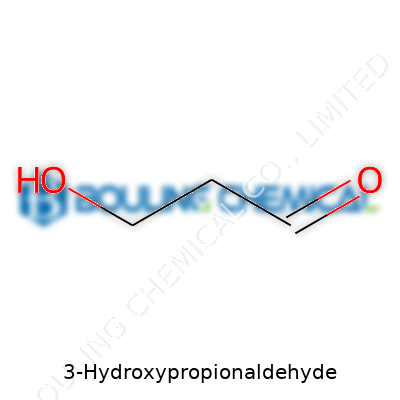
3-Hydroxypropionaldehyde is best described as a colorless liquid or sometimes a syrup, with a sharp odor. Its main appeal is that it behaves both as an aldehyde and an alcohol, making it flexible in the lab and in industry. The molecule is straightforward, bearing a three-carbon skeleton with an aldehyde group on one side and a hydroxyl group hanging off the middle. This split personality gives it versatility: those two reactive ends open up chances for further chemical modification down the line. Few compounds strike this balance between reactivity and stability, and that’s part of the reason chemists keep coming back to it.
This chemical weighs in at about 74 grams per mole and carries the formula C3H6O2. Left in a bottle, it doesn’t like sitting around – it can polymerize, especially in presence of acids or bases, so storage and handling call for care. It dissolves easily in water and many organic solvents, which means it moves between phases without trouble. It isn’t especially volatile, but extended exposure to air tends to make it degrade unless stabilized. These practical considerations affect both its transport and its use in the lab, and they sometimes stand in the way of broader adoption.
Industry usually tracks this chemical by its purity and stabilizer content. Since 3-HPA degrades if you blink at it, stabilizers like bisulfite often hitch a ride in production batches. Manufacturers stamp containers with hazard labels, reminding anyone who handles it that it can be harmful by inhalation and skin contact. Clear records and transparent documentation are not just bureaucracy here; they help prevent costly mistakes and reduce health risks during transportation and storage.
Most production routes lead back to either the hydration of acrolein or the biotechnological conversion of glycerol. Both methods have their pros and cons. Hydration of acrolein means dealing with a toxic and unstable intermediate, which requires careful engineering. Biotechnological production uses microbes, particularly certain bacteria, to munch on glycerol and spit out 3-HPA. This method gets points for using renewable feedstocks and tends to run at lower temperatures, giving it a slight edge in terms of safety and sustainability. Newer research focuses on genetically engineered strains of bacteria or yeast, aiming to push yields higher and costs lower.
3-HPA doesn't stay put for long. The aldehyde group likes to condense with amines or undergo polymerization, and the hydroxyl group adds further flexibility. It acts as a starting point for a variety of other chemicals. For example, 1,3-propanediol—a key ingredient in some bio-based plastics—comes from simple reduction of 3-HPA. The chemical also takes part in cross-linking reactions for polymer science or acts as a functional intermediate for surfactant synthesis. The multiple transformation routes make it a valuable gateway between raw industrial chemicals and finished products.
Sometimes, chemical names hide more than they reveal. 3-Hydroxypropionaldehyde goes by a handful of aliases. Some chemists call it beta-hydroxypropionaldehyde or 1,3-dihydroxy-2-propanone, depending on the context of the reactions they’re interested in. Industrial circles sometimes simplify things with abbreviations like 3-HPA, while regulatory schemes tend to use less creative identifiers. This tangle of names can complicate literature searches for those not familiar with the territory, but at the end of the day, they all circle back to the same versatile molecule.
Handling 3-HPA demands close attention to lab protocols. The chemical vapor and solution can irritate the eyes and skin. Prolonged or high-level exposure can cause respiratory trouble, and contact should be avoided as much as possible. Using fume hoods, gloves, and face protection isn’t just suggested; it’s necessary. Facilities working with the compound need to keep spill kits and eyewash stations on hand, not to mention clear instructions for safe disposal. These requirements draw not just from safety data sheets, but from years of lab accidents and medical reports. Regulations governing transportation and labeling keep tightening as more information about the compound’s health and environmental impact comes to light.
Looking at where 3-HPA shows up outside the factory, the story is broad. One of the biggest applications remains the route to 1,3-propanediol for use in polytrimethylene terephthalate (PTT) fibers, which find their way into carpets, textiles, and new classes of plastics. Smaller scale uses include cross-linkers for resins, intermediates in pharmaceuticals, and even as antimicrobial agents—though this last use has sparked debates about safety and environmental effects. In research settings, bioconversion experiments often rely on 3-HPA as a benchmark for metabolic engineering performance, showing how efficiently microbes can channel carbon from cheap starting feedstocks into more valuable products.
Research into 3-HPA keeps grinding forward, with R&D often motivated by economic and environmental pressures. Laboratories worldwide push for better microbial strains, more efficient catalysts for chemical synthesis, and methods that minimize waste or sidestep dangerous intermediates. Projects funded by both governments and the private sector target ways to replace fossil fuel-derived chemicals with ones based on renewable 3-HPA. There’s plenty of attention on containment, process safety, and automation, not just because of the compound’s hazards but due to the increasing demand for precision and consistency in chemical manufacturing.
Opinions about 3-HPA in terms of toxicity are shaped by both animal studies and lab mishaps. It acts as a potent irritant and, in some studies, demonstrates cytotoxic effects at low concentrations. In humans, accidental exposure can cause skin rashes, burning sensations, and respiratory distress. Long-term effects aren’t as well documented, which worries some environmental health researchers. Part of the trouble comes from the way 3-HPA breaks down in water and air, producing a variety of secondary products whose effects aren’t always predictable. Debates continue as to the best safety thresholds, prompting calls for more comprehensive animal and cellular studies.
3-Hydroxypropionaldehyde stands at a crossroad. New biotechnological advances hint at cheaper and cleaner production, which would give this chemical a shot at wider industrial adoption. It could anchor supply chains for bio-based plastics, specialty chemicals, and even pharmaceutical products. At the same time, issues of safety, toxicity, and environmental fate need attention. Regulatory scrutiny and market acceptance will drive the next wave of research and production. The race is on to balance reactivity, cost, and safety in ways that unlock the compound’s potential without repeating the mistakes that have haunted industrial chemistry’s past. As renewable feedstocks become more common, 3-HPA could shift from an obscure intermediate to a mainstay of greener industry.
A lot of people haven’t heard of 3-Hydroxypropionaldehyde, or 3-HPA for short. In the lab world, though, this compound gets plenty of attention. It serves as a key starting point for making valuable things like acrylic acid, a workhorse in plastics and superabsorbent polymers found in diapers and personal care products. Without these building blocks, many items that folks use daily would look pretty different. The science behind it isn’t flashy, but the impact stretches out into everyday life.
One intriguing thing about 3-HPA lies in how it gets made. Some researchers are figuring out ways to make it from renewable sources, including glycerol—a byproduct from biodiesel production. This idea isn’t some green buzzword; it’s about taking the leftovers from one industry and turning them into something useful in another. Biotechnology companies are betting on these routes to lower the world’s reliance on fossil fuels and cut down waste. It’s the kind of circular thinking that should get more attention.
Acrylic plastics, coatings, and fibers depend on chemicals derived from 3-HPA. The wide use of these products in construction, medical devices, paints, and adhesives ties back to this one compound. The stakes go up when you see how demand for these materials rises each year. Finding more sustainable ways to produce the basics supports supply lines not only for high-tech applications but also for simple household goods.
Working with 3-HPA means dealing with its quirks. The chemical’s reactive nature creates hurdles in storage and transport. Some companies try to navigate these issues by producing fresh batches when and where they need them, instead of shipping the liquid around the globe. Small improvements in handling might not make the headlines, but they shape safety and efficiency behind the scenes.
Health isn’t just a discussion for scientists in white coats. 3-HPA has some toxic qualities—it can be irritating to the skin, eyes, and airways. Workers on the front lines, the folks mixing vats and monitoring reactors, deserve practices that put safety first. The drive to engineer safer processes or develop less hazardous alternatives links directly to real faces, real hands, and real families relying on that paycheck at the end of the week.
Sustainable solutions push this story forward. R&D groups experiment with new catalysts and fermentation techniques trying to get 3-HPA from plant-based soaps or sugars instead of oil. Still, industry inertia leaves plenty of fossil-fuel processes running, slow to change. Investment in greener chemistry opens new doors—ones leading toward less pollution and better worker safety. Governments and customers who buy the final products can apply pressure here, voting with contracts and consumer choices.
3-Hydroxypropionaldehyde gets little public spotlight. Yet, this molecule links farms to factories, diapers to doctors, and connects problems like waste management with cleaner manufacturing. I’ve watched people—scientists, plant operators, safety inspectors—wrestle with these decisions over coffee and late nights because these challenges aren’t abstract. They show up in air quality, water safety, and the well-being of actual neighborhoods. Every push toward smarter production and stronger regulations isn’t just technical progress; it’s a real win for the world we share.
3-Hydroxypropionaldehyde doesn’t get much attention outside of labs. Anyone who’s handled this chemical knows it can be a handful—unstable, reactive, and quick to spoil when left out in the open. On paper, it’s often listed as sensitive to air and light. That barely scratches the surface. I’ve seen curious grad students pop open an unprotected container and find their sample already starting to polymerize, putting research at risk and wasting money. For anyone storing, researching, or working with this compound, following a real-world storage routine pays off in ways that lab safety sheets alone can’t guarantee.
This isn’t one of those chemicals you can safely tuck in a drawer. Its high reactivity makes it prone to oxidation. Just letting a half-used bottle sit out between experiments can lead to unwanted byproducts and sometimes, even a sticky mess. In one lab I worked with, a shipment left on a courier’s truck overnight was a goner by the time we opened it. With air and moisture in the mix, 3-HPA starts to break down, which can ruin sample purity, throw off measurements, and even plant the seeds for fires if mixed with the wrong stuff.
For anyone interested in chemical research, the integrity of a compound like 3-HPA matters. Losing a sample could mean days or weeks of repeating the same work, sometimes with grant money on the line. Standard lab fridges and routine handling won’t cut it. Getting the storage routine right means:
Safety isn't just about ticking boxes for compliance offices or inspector checklists. It’s about people around you: chemists, cleaners, even the legal team if something goes wrong. A casual approach risks more than spoiled samples—it can lead to hazardous fumes or injuries. For anyone in an industrial setting, these mishaps cost more than inconvenience. Medical literature has reported issues including respiratory irritation and skin burns from accidental exposure. That illustrates why attention to proper storage isn’t just a chore, but real stewardship over workplace health.
Labs working with 3-HPA often assign one person to double-check storage every day. They make sure seals are tight, desiccants are changed, and nothing sits out longer than needed. Sometimes, ordering smaller quantities makes more sense, even if it costs more upfront. Cutting corners with bulk orders often ends with most of the batch being thrown out, chalked up as “learning expenses.”
For anyone weighing the risks, asking experienced colleagues always beats guessing from a datasheet. The cost of spoiled material, wasted labor, or a health incident is far more than the price of a good fridge and some patience in following best practices.
Some chemicals carry warning labels for a reason. 3-Hydroxypropionaldehyde, often called reuterin, might not be a household word, but it crops up in research labs, industry, and even some types of fermentation. It’s got a reputation as a useful intermediate for plastics, resins, and even food chemistry. But the question rolls in every time: is it hazardous or toxic?
From my own work around fermentation and chemical safety, I’ve seen far too much confusion about what toxicity actually means. Just because something comes from a “natural” process—or shows up in a test tube—doesn’t mean it’s harmless. For 3-Hydroxypropionaldehyde, most sources agree: it’s toxic in moderate amounts, irritating to the skin, eyes, and airways. The backbone of these reports traces back to laboratory studies, which show this compound can damage exposed tissue, disrupt cell processes, and mess with normal metabolism.
If you breathe it in, you might feel a burning sensation or start coughing—workers in chemical plants often notice quick discomfort if exposed without proper safety gear. Skin contact could leave you with redness or even blisters at higher concentrations. Nobody relishes the idea of splashing something like this into their eyes, but eye contact often leads to immediate pain and possible long-term vision trouble.
What sort of numbers put this in context? Research over the years points out that rodents suffer organ damage and sometimes death at doses below a gram per kilogram of body weight. No one should treat such findings lightly, even if most people will never run into pure 3-Hydroxypropionaldehyde in daily life.
I’ve found that just screaming “hazard” rarely helps anyone. The trouble lies in how, where, and how much you meet this chemical. Inside a high-standard lab, personal protective equipment reduces risk. Strong ventilation, stringent handling practices, and proper training keep workers safer. Industry regulations already require risk assessments and exposure controls for anyone working around substances with known hazards.
Food and biotech settings complicate things, though. Tiny amounts of 3-Hydroxypropionaldehyde sometimes turn up in cheese or fermented foods—it’s even made by gut bacteria. Yet these trace levels likely don’t reach anywhere near the concentrations that cause harm. The dose always matters. In contrast, if you’re bottling or transporting the pure chemical, slip-ups pose a much greater threat.
I strongly believe in honest, evidence-driven guidance. Companies using 3-Hydroxypropionaldehyde benefit most from clear staff training, easy-to-follow exposure limits, and emergency plans in case of spills or exposures. Health monitoring among workers pays off over time, uncovering issues early before damage sets in. Regular review of scientific literature helps update safety standards—something too many workplaces ignore.
For researchers, transparent reporting of health effects furthers the field. It helps regulators fine-tune the right exposure limits and encourages companies to find alternatives where possible.
In the end, 3-Hydroxypropionaldehyde is hazardous and toxic enough to warrant careful handling. Appropriate respect, well-maintained protective gear, and solid procedures go a long way toward keeping people safe. The line between safe and unsafe shifts with how much and how often you’re exposed, but downplaying risk never helps. I wouldn’t want to scare anyone off from chemistry or science, but safety should always come first—backed by real evidence, not guesswork.
Scrolling through chemical catalogs, names can look like coded mysteries. Take 3-Hydroxypropionaldehyde: it doesn’t sound like a headline-maker, but in the lab, simple molecules often make outsized impacts. I’ve spent years in research, tinkering with small chemicals and watching them trip huge dominoes in both biology and industry. There’s an art to noticing why certain molecular shapes matter, especially after realizing how minor atomic shuffles create a world of different properties.
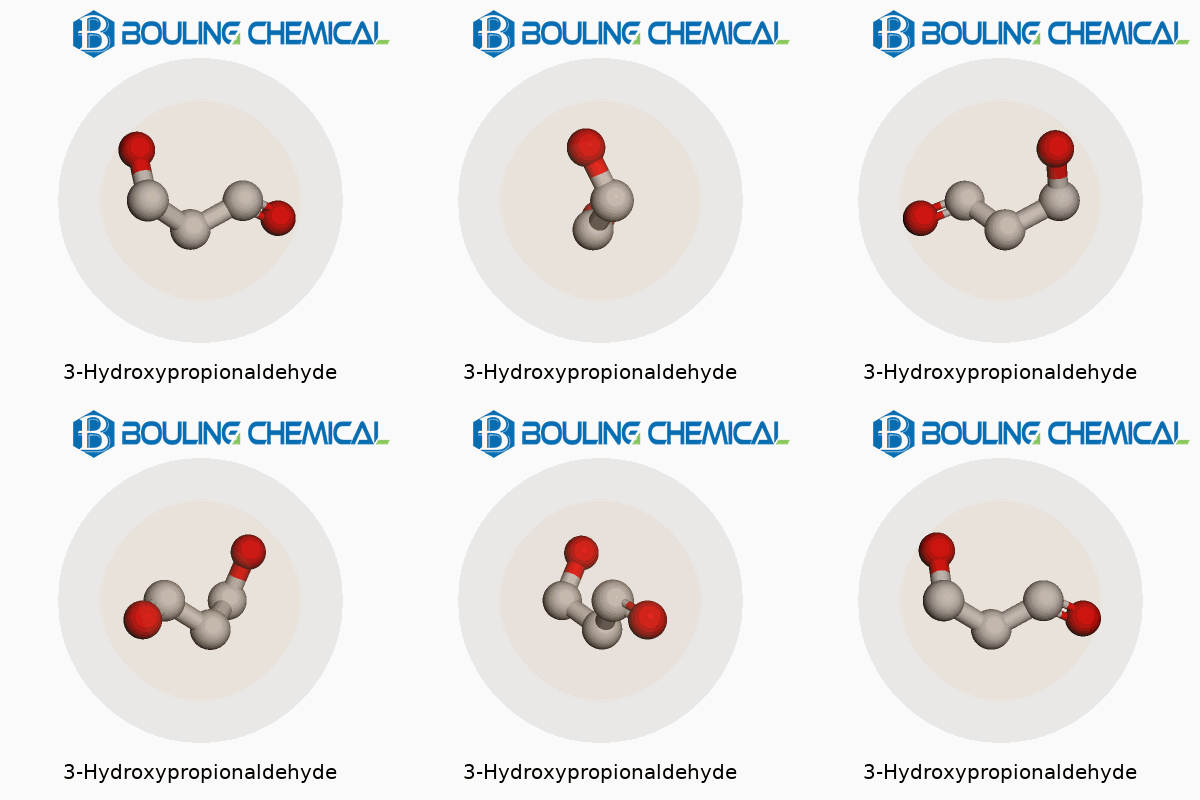
Picture a short chain of three carbon atoms. On one end, you find an aldehyde group—a carbon double-bonded to oxygen and single-bonded to hydrogen. On the middle carbon, a hydroxyl group—an oxygen and a hydrogen—hangs off. The third carbon rounds out the chain with hydrogens. Chemists call that layout C3H6O2. Written out, it’s HO–CH2–CH2–CHO. This split identity—both an alcohol and an aldehyde—gives the molecule unpredictable behavior. It reacts with water, other alcohols, and even itself. That’s chemistry’s version of a wild card.
In real research and manufacturing, I’ve seen how molecules that can “play both sides”—being both alcohol and aldehyde—open up unique pathways. 3-Hydroxypropionaldehyde is no exception. Its duality means you can convert it into all sorts of chemical products. It serves as a stepping stone in making acrylics, plastics, and even some potential biofuels. There’s an ongoing push to pull substances like this from renewable sources, not barrels of oil. Microbes can churn out 3-Hydroxypropionaldehyde from common sugars, which interested many in the search for greener chemistry.
Molecules with more than one active group can become unstable. 3-Hydroxypropionaldehyde wants to react—sometimes more than its creators would like. In water, it can break down or stick to other molecules, leading to complications when trying to bottle or ship it. My early work in fermentation labs showed this first hand; oftentimes, we had more byproducts than the compound we wanted. Stable handling and smart storage are ongoing struggles for teams hoping to scale up its use.
There’s been an increased focus in recent years on using basic biology—think genetically tweaked bacteria—to manufacture building block chemicals. By closing the gap between raw plant sugars and molecules like 3-Hydroxypropionaldehyde, bioengineering offers a way to step off the crude oil train. The catch comes with keeping these reactive molecules in check. Better equipment, stronger process control, and smarter microbes are all under the microscope. Even small process tweaks, such as changing pH or temperature, can tip the scales in favor of higher yields and fewer unwanted side-reactions.
As chemical manufacturing shifts toward more sustainable processes, it pays off to rethink the roles of molecules like 3-Hydroxypropionaldehyde. Paying attention to both its structure and its quirks points research toward safer, more efficient uses. Investments in process optimization and microbial engineering could turn what once seemed like a temperamental lab chemical into a key pillar of green industry. Tiny changes at the atomic level lead to meaningful impacts on the health of the planet and the future of manufacturing.
Most people haven’t heard much about 3-hydroxypropionaldehyde unless they’ve spent some late nights in a chemistry lab or followed the latest news on bio-based chemicals. But this molecule keeps popping up as interest in sustainable chemistry gains steam. It’s not flashy, and it won’t show up on your grocery shelf, but its role in making valuable chemicals means the way we produce it actually shapes the future of everyday products—from plastics to feed additives.
A bulk of 3-hydroxypropionaldehyde starts with something simple: sugar. Not unlike brewing beer, scientists have trained certain bacteria to chew through glycerol and produce this compound. Klebsiella pneumoniae is one microbe that likes this job. Feed it glycerol—often a byproduct of biodiesel production—and it cranks out 3-hydroxypropionaldehyde in anaerobic conditions. This isn’t just a neat trick for researchers. There’s a real economic edge to harnessing microbes since the process sidesteps the harsh conditions of conventional synthesis and works at lower energy.
I remember talking to a chemical engineer whose lab was buzzing about ways to optimize these microbial reactors. Controlling oxygen, keeping byproducts in check, and getting the bacteria to tolerate the accumulating 3-hydroxypropionaldehyde became their daily struggle. These aren’t small-scale headaches. When you fill big fermenters, even tiny efficiency losses add up, and the bacteria don’t like working in a hostile soup of their own product. Finding those robust bacterial strains—ones that don’t throw in the towel as soon as their surroundings change—feels like searching for a needle in a haystack. But recent advances in genetic engineering and process monitoring have started turning the tide, at least in pilot studies.
Chemists still lean on classic reactions to produce 3-hydroxypropionaldehyde, though. The industrial method usually starts with acrolein, which reacts with water in the presence of acid. Acrolein doesn’t have the friendliest reputation in the workplace—it’s pungent and dangerous, so handling it safely costs time and money. The reaction gives decent yields, especially at a commercial scale, but I’ve seen factory workers suit up like they’re handling a moon rock before even walking into the acrolein area. Not everyone feels comfortable bringing these risks into their backyard, and local communities push back when new plants arrive. It’s tough to ignore the tradeoff between chemical yield and the headaches of hazardous materials management.
The push toward biobased manufacturing isn’t slowing down. As the world looks for ways to break free from fossil-based chemicals, microbial synthesis of 3-hydroxypropionaldehyde keeps getting attention. Upscaling these processes still presents hurdles; keeping costs in check and maintaining steady production remain real concerns. Policy incentives and carbon pricing might help shift the balance, making safer bioprocesses more attractive to companies that, until now, stuck with the tried-and-true chemical route.
There’s no silver bullet. More research, smarter engineering, and creative process improvements sit on the horizon. As lab tech meets climate pressure and market demand, the way we make niche chemicals like 3-hydroxypropionaldehyde gives us a glimpse into broader shifts coming for industry. That’s why lab innovations and shop-floor know-how matter so much in this space.