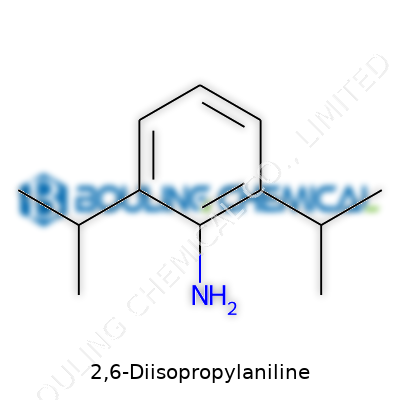
Chemists have shaped modern life with molecules that barely show up on the radar of the average person, and 2,6-Diisopropylaniline stands as a clear example. Stemming from the efforts in the 20th century to fine-tune aromatic amines, its discovery wasn’t a matter of chance but of demand. The push for selective catalysts and ligands for growing organic synthesis needs put this compound on the map. In those days, researchers primarily worked with basic anilines before realizing that bulkier alkyl substituents at the ortho positions gave unique steric properties—opening doors for new reactions and more robust catalysts. Older trends in organic chemistry relied more on simpler anilines. Once the benefits of 2,6-disubstitution became obvious, interest shifted to compounds like 2,6-Diisopropylaniline for optimizing yields, selectivities, and to combat issues with steric hindrance.
2,6-Diisopropylaniline offers more than just another amine on the shelf. With the structural backbone of aniline and bulky isopropyl groups, chemists found a compound capable of resisting unwanted reactions that plague other anilines. Not only does this shape its function as a ligand, but it also proves crucial as an intermediate in agricultural, pharmaceutical, and material science applications. Laboratories keep it on hand as a staple for producing sterically crowded Schiff bases or as a core for ligands in metal-catalyzed cross-coupling. In my own experience, one appreciates its versatility when seeking both stability and accessibility in synthesis, especially compared to simpler ring-substituted anilines that rapidly oxidize or polymerize under similar conditions.
This compound is a colorless to pale yellow liquid under standard conditions, distinct from the crystalline demeanor of many aromatic amines. Its boiling point usually hovers near 266–268°C, and it’s only slightly soluble in water, but it dissolves well in organic solvents like ether, acetone, benzene, and chloroform. I have handled it during ligand formation, noting its strong amine odor and the high viscosity owing to its bulky ortho substituents. The steric effect of the isopropyl groups protects the amine nitrogen, making it less prone to electrophilic substitution on the ring, and less susceptible to air oxidation than unsubstituted or less hindered anilines. Compared to more reactive analogs, the improved chemical stability reduces waste and the risk of hazardous byproducts.
2,6-Diisopropylaniline comes labelled by its common name, but also answers to N-(1-methylethyl)-benzenamine among others. Most suppliers indicate a purity upwards of 98%, which matters since trace metal or halide contaminants can wreak havoc in catalysis. Its CAS number, 24544-04-5, helps avoid confusion in procurement or regulatory discussions. Labels typically flag it as a flammable liquid and toxic by inhalation or skin contact. For years, the trend has leaned toward safer packaging—amber bottles limit photodegradation, and clear hazard pictograms keep lab techs alert. In my own routines, attention to lot number and production date always comes before weighing out a single drop, especially given its propensity to pick up trace oxidants.
Traditional preparation routes involve Friedel-Crafts alkylation of aniline, often mediated by acidic catalysts, with propylene or isopropyl halides. In the lab, this reaction seems straightforward, but controlling polysubstitution and tar formation challenges even experienced chemists. More recent approaches pivot toward milder Lewis acids or ionic liquids to increase yield and reduce environmental waste. Where I have seen the biggest improvements is in scaling up—the reactors used nowadays offer better temperature control, preventing decomposition and keeping isopropylation selective to the 2,6 positions. Some high-end labs opt for catalytic hydrogenation pathways with suitable precursors, giving better atom economy and cleaner product streams.
As a starting material, 2,6-Diisopropylaniline’s bulky ortho isopropyls set the rules for how it reacts and with what. Forming Schiff bases or imines with various aldehydes comes off cleanly, and the resulting products often show enhanced thermal or oxidative stability. It also serves as a precursor for bi- and polydentate ligands, vital for transition metal catalysis. Personal experience has shown the critical difference this makes: ligands derived from this aniline fend off ligand exchange better, thanks to the crowding effect, keeping metal centers more active for longer periods. Bromination or nitration barely touches the ring in standard conditions, so for directed modification, chemists turn to more specialized activating agents or resort to ortho-metalation with organolithium reagents. Each step brings its own set of handling quirks and hazard considerations, reminding chemists to keep safety front of mind.
Besides 2,6-Diisopropylaniline, this compound turns up in catalogs under labels like 2,6-bis(1-methylethyl)aniline, N-(1-methylethyl)-benzenamine, or even 2,6-DIPA. The variety of names stems from the movement across different language and chemical registry systems. For researchers and industry professionals, sticking to the CAS number during ordering keeps mistakes at bay, especially since similar-sounding isomers can lead to entirely different physical outcomes in a synthesis run.
Navigating the risks with aromatic amines takes diligence. 2,6-Diisopropylaniline deserves respect—skin and respiratory sensitization, possible mutagenicity, and flammability show up in its main risk profile. Gloves and fume hoods form the first line of defense in any lab I’ve worked in. Waste management for this class of amines involves strict segregation as oxidizing contaminants can trigger exothermic side reactions. Global safety standards recommend clear hazard communication, including pictograms and hazard statements conforming to GHS. Experienced chemists often insist on periodic air monitoring when running large-scale processes, given the volatility. Regular training on best practices, combined with rigorous spill response planning, cut down on accidents compared to ad-hoc approaches from earlier decades.
Applications for 2,6-Diisopropylaniline extend well beyond academic curiosity. The properties that come from its hindered structure make it a core player in crop protection—serving as an intermediate for herbicides and pesticides where selectivity and environmental stability count. Pharmaceutical researchers blend it into the backbone of antihistamines and analgesic drugs. In materials science, its derivatives act as building blocks for specialty polymers and high-temperature resins, especially where resistance to oxidation or moisture absorption matters. My own brush with its applications came in the fine-tuning of photoinitiators for UV-curable coatings. Since the molecule’s structure keeps unwanted side reactions down, final products hit markets with longer shelf-lives and better processing windows, which satisfy both food packaging and electronics manufacturers.
Academic and industrial labs keep returning to 2,6-Diisopropylaniline, searching for ways to unlock more potential from its core structure. Recent years have seen it pop up in papers on novel ligand frameworks for transition metal complexes, pushing forward cross-coupling and hydrogenation chemistry. Lab groups focus on developing greener synthesis routes—leaning into less toxic catalysts, recyclable solvents, and continuous flow methods. R&D efforts also explore its use in organic electronics, exploiting the stability and planarity the molecule confers for improved charge transport in OLEDs and organic transistors. A major research emphasis falls on improving atom economy during synthesis and finding downstream uses that minimize leftover hazardous byproducts. Progress moves fastest in universities that run strong industry partnerships, proving that market-driven questions often incubate the most practical scientific advances.
Toxicological profiling has trailed many aromatic amines, and 2,6-Diisopropylaniline is no exception. Animal studies point toward moderate acute toxicity, especially by inhalation and skin contact. Reports mention potential for cumulative effects on liver and kidney function at high or prolonged exposure. In vitro assays hint at weak mutagenicity, though long-term epidemiological data remain scarce compared to more notorious anilines. Regulators in Europe and North America treat it as a hazardous substance deserving careful documentation in workplace inventories. For chemists entrusted with student safety or environmental stewardship, limiting exposures and monitoring waste keeps risks in check. Realizing how persistent some metabolites can be encourages ongoing research into both safer alternatives and rapid degradation technologies for water treatment facilities.
Looking ahead, demand for 2,6-Diisopropylaniline will ride on the back of both emerging clean-tech applications and the steady need for improved agrochemicals and smart materials. Advances in organic catalysis and polymer science open up new markets, especially as electronics seek more durable, heat-resistant organic components. Sustainability concerns push chemists to squeeze more value out of every batch, and the field needs greener production methods to curb both energy use and hazardous byproducts. Part of the evolution lies in designing derivatives that tick both the performance and regulatory boxes. If the community continues investing in better toxicological screening and in life-cycle analysis, the molecule’s reputation can remain more positive than many of its aromatic peers. Investments in recycling and reclamation technology—returning unused or spent material safely—could set standards for a new generation of specialty chemicals. In the end, 2,6-Diisopropylaniline’s continued relevance depends on creative, responsible use tied closely to a deep understanding of both benefit and risk.
I’ve always seen the world of chemicals as a bit of a puzzle, where the right piece in the right place creates new technology and medicines we sometimes take for granted. 2,6-Diisopropylaniline might sound like something reserved for chemistry textbooks, but its impact runs deeper than most people realize.
Anyone diving into organic synthesis will likely cross paths with 2,6-Diisopropylaniline. Chemists value this compound for its bulky structure, which protects certain reactions from going down the wrong path. In my own years in the lab, adding this molecule changed the game during the creation of specialized ligands—those are the chemical tools that help metals become "catalysts," speeding up key reactions for drug development and material science. Its presence shapes reaction landscapes, ensuring that specific components latch together cleanly rather than creating a mess of byproducts. This sort of control matters when people depend on targeted cancer drugs or crop protection agents. Patients and farmers never see this molecule, but its effect trickles down to their everyday experience.
2,6-Diisopropylaniline serves as more than a helper in pharmaceutical labs. Industries often rely on it to produce fine chemicals with tailored properties. Years ago, while working with a team aiming to improve fluorescent dyes for biological imaging, I saw how this compound strengthened the color and stability of the end product. Down the supply chain, researchers use these materials in cutting-edge diagnostic tests and electronics. Their performance influences how precisely doctors spot cancerous cells or how reliably data can be displayed on screens.
Working with chemical building blocks means understanding their risks. 2,6-Diisopropylaniline, like many industrial chemicals, comes with health concerns if handled carelessly. Overexposure can irritate skin or lungs. It’s essential for labs and factories to follow strict protocols and to provide workers with training and protective equipment. Decades of incidents across the industry remind us that complacency opens the door to accidents. Investment in proper ventilation systems and ongoing safety audits prevents avoidable harm. Companies owe it to their employees—and their customers—to treat chemical stewardship as a core value, not as a box to check.
One big challenge facing chemical producers is the environmental impact of their processes. Traditional manufacturing routes for 2,6-Diisopropylaniline often generate waste or involve hazardous intermediates. Academic groups have started exploring methods that generate less waste and use safer solvents. Early results look promising, though scaling up these approaches takes money, patience, and regulatory support. As society grows more aware of how factory emissions and waste affect local communities, there's pressure to rethink how base chemicals like this one reach the market. Funding research partnerships and rewarding eco-friendly practices could speed up adoption of cleaner production.
Most people will never buy 2,6-Diisopropylaniline at the store, but they benefit from its use every day. From cancer treatments to food safety, its influence extends far beyond the factory walls. The push toward sustainable chemistry offers a chance not only to keep those benefits coming, but also to ensure the costs to communities and the planet don't go ignored. It's another chapter in the story of how a simple molecule can unlock advancements, provided we keep responsibility and innovation at the forefront.
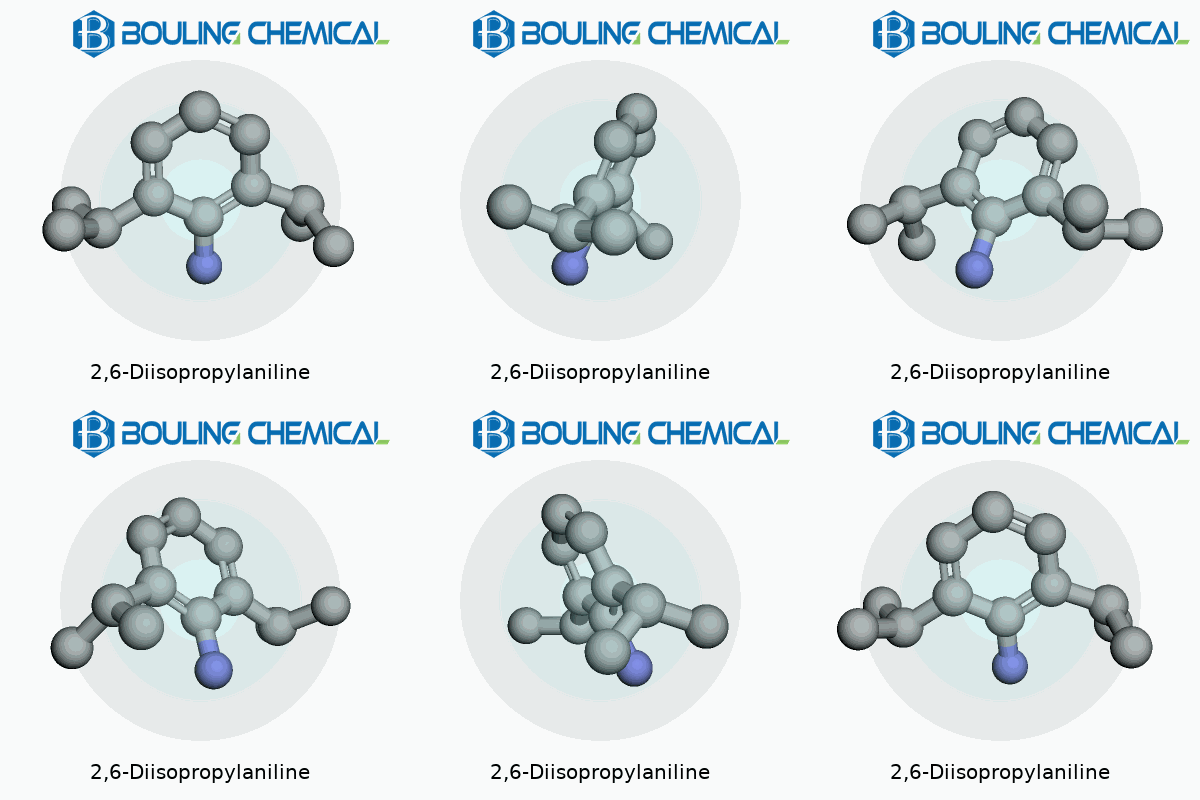
2,6-Diisopropylaniline stands out as a core building block in the chemical world. With the chemical formula C12H19N and a molecular weight of almost 177.29 grams per mole, it sits in a place of practical value for laboratories and industry workers who handle aromatic amine compounds. This isn’t just another name in a chemical catalog—its unique structure opens doors to many processes in pharmaceuticals, agrochemicals, and materials science. The structure features an aniline backbone fitted with isopropyl groups at the 2 and 6 positions, which means more bulk and added stability that often proves useful for advanced syntheses.
From my own years in the research trenches, I’ve seen how knowing both the chemical formula and precise molecular weight can avoid real headaches. Synthesizing new compounds or scaling up processes gets risky fast if molecular weights are off. Accurate weights guide dose calculations and reactions, preventing wasted resources and dangerous mishaps. In pharmaceutical and crop protection work, slight miscalculations can mean failed tests, wasted batches, or worse, unexpected reactivity on a large scale. When you’re running a reaction to attach a ligand to a bulky aniline, knowing you’re working with C12H19N and its weight lets you calculate stoichiometry precisely—saving time and expensive materials.
People may overlook this compound, but it acts as a quiet force behind innovations. Its stubborn shape blocks unwanted reactions, which is a gift for researchers trying to create custom ligands or tweak a metal’s coordination environment. In organometallic chemistry, 2,6-Diisopropylaniline derivatives have helped scientists tame reactive metalloenzymes, giving industry a path to safer and more selective catalysts. Better catalysts shrink emissions and boost product yields, small victories that snowball into real gains in both sustainability and business.
Mistakes in reporting formulas or molecular weights have damaged careers and wasted years of research time. Sourcing reliable material—direct from reputable databases or peer-reviewed articles—matters now more than ever. I’ve witnessed firsthand how casual mistakes ripple through teams: a miscalculated synthesis leads to faulty data, which sets the next experiment back weeks or months. Sharing chemical knowledge with rigor reflects a commitment to the shared integrity of the scientific field, with trust earned through double-checking and cross-referencing, not just relying on one online source.
Laboratories hoping to work with 2,6-Diisopropylaniline or any compound with specialized use ought to standardize their verification steps. Routine checks—comparing values from multiple sources, and even running basic analytical tests in-house—create resilient workflows. This discipline loops back to the fundamentals: starting with solid information lowers risk and builds a foundation for creative work in the long run.
In short, respect for chemical fundamentals—like knowing the true formula and weight—underpins every success story in synthesis and applied research. 2,6-Diisopropylaniline might sound like a small player, but its measured presence unlocks opportunities across the sciences, provided accuracy and diligence guide each step.
Every day, chemicals shape modern life, often behind the scenes. 2,6-Diisopropylaniline sits in a long list of substances used by researchers, manufacturers, and students in classrooms. Lab bottles rarely grab attention until someone raises a question: is this compound toxic or hazardous?
2,6-Diisopropylaniline wears a long name, but its roots lie in aniline, a building block for dyes, pharmaceuticals, and rubbers. Chemical labs use this modified form as an intermediate during the creation of other chemicals. Folks handling it might not realize what it can do outside the container.
After working around the chemical industry, I’ve learned to pay attention to substances carrying an “aniline” name. Small tweaks in molecules sometimes bring big shifts in safety. With 2,6-Diisopropylaniline, reported hazards come primarily through skin contact, breathing in dust, or accidentally getting it in your eyes. Burning eyes, headaches, or irritated skin often signal something's wrong.
Structurally, it belongs to a class of compounds where caution matters. Regular aniline itself carries a reputation both for toxicity and for being tough on oxygen-carrying blood cells. This analog tends to show mild acute effects, yet repeated exposure links to longer-term health risks. I’ve seen cases where lack of proper gloves and good ventilation led to nasty rashes and chronic coughs in colleagues who spent too long working with these aromatic amines.
Laboratory animal studies on related chemicals show organ irritation, potential blood changes, and sometimes effects on the nervous system. Data for this exact compound remains limited, which always rings alarm bells for those keen on occupational safety. Without robust human studies, it pays to use extra caution.
Many ignore chemicals with complicated names—until someone gets sick. Most accidents happen because people underestimate what they’re handling, or miss updates to safety guidelines. The presence of 2,6-Diisopropylaniline within research, manufacturing, and educational settings creates a mixed picture. Chemical plants might invest in modern fume hoods, gloves, and continuous air monitoring. Smaller outfits or schools often lag far behind, increasing the odds for slips and accidental poisonings.
Another problem lies in waste. Discarded aniline compounds, including this one, can flow through drains or land in regular trash if folks grow careless. These molecules show persistence in groundwater and soils, and can poison ecosystems in subtle ways. Some aniline derivatives disrupt aquatic life, stunting growth or damaging sensitive embryos. These effects ripple up the food web.
In my experience, real change doesn’t come from thick binders of regulations, but from routine safety culture. Regular training, properly labeled bottles, and the right gloves matter as much as high-level compliance. Adding fact-based hazard communication—from the classroom up to the boardroom—closes the knowledge gap that leads to accidents.
Switching to less risky alternatives also deserves a hard look. Mindful substitution, where possible, reduces exposure from the start. In cases where you can’t swap out 2,6-Diisopropylaniline, tight engineering controls—think direct exhaust systems and rigorous spill response plans—set the foundation for protection. Forgetting or skipping these steps usually ends poorly.
Cheapness and convenience drive widespread chemical use. Sometimes people see “no acute risk” on data sheets and let their guard down. Yet, lived experience shows that after-the-fact cleanup and health bills far outweigh the costs of safer practices. By treating 2,6-Diisopropylaniline with healthy respect and insisting on high safety standards, we shrink the odds of harm for ourselves and generations ahead.
Anyone who’s spent time in a chemistry lab knows the unwritten rule: treat every bottle on the shelf with respect, even when the label seems a little obscure. 2,6-Diisopropylaniline falls into that camp. You don’t see it in daily headlines, but miss a step in handling, and it will quickly make you wish you’d paid attention. From my years working with specialty chemicals, I learned early that routine can offer a false sense of safety. The real safety comes from understanding what you’re dealing with—and not cutting corners.
Walk into a stockroom and you’ll notice how some chemicals sit under lock and key, or behind yellowed glass. There’s a good reason for that. 2,6-Diisopropylaniline isn’t an explosive or a rocket fuel—it's often part of building blocks for dyes, pharmaceuticals, and advanced materials. Still, its reactive amine group can turn a “regular workday” into something memorable for the wrong reasons. Stash this chemical in the wrong spot—like near oxidizing agents or acids—and you set up an accident that moves from textbook hazard to real-world cleanup.
I’ve seen labs that kept “just a little” of something nasty on a high shelf, covered in dust, because “nobody ever touches it.” Problems rarely announce themselves before they show up. Add a hot summer afternoon, or a bit of a leak from a neighboring container, and things change. 2,6-Diisopropylaniline shares this risk. Even small spills create fumes that sting eyes and irritate skin. Years back, incomplete labeling led to a colleague confusing amines with a solvent. It only took minutes for the skin irritation to prove how careless labeling multiplies harm. That memory sticks around whenever I wonder about storage diligence.
Using metal or tightly sealed glass containers limits air and moisture getting in, which really cuts down on unnecessary reactions. Don’t leave it sitting in direct sunlight or anywhere temperatures bounce around. That’s asking for decomposition and extra vapor buildup. Always keep it physically separated from acids, oxidizers, and sources of ignition—even something basic like an open flame on a hotplate.
Anyone handling 2,6-Diisopropylaniline should wear gloves that hold up to organic chemicals, along with goggles—not just glasses. Ventilation matters much more than many people admit. Fume hoods aren’t optional; they keep you from breathing in irritant vapors that aren’t always obvious. Long sleeves and lab coats save you from those accidental droplets or spills that love to find bare skin.
OSHA and similar authorities have written pages on proper chemical storage, but none of those rules help if no one pays attention or takes shortcuts out of habit. Regular reminders and training provide the best prevention—label reading, storage checks, and spill drills actually stop emergencies before they start. That means every new person in a chemical workspace should observe not just the rules, but why those rules exist. If someone finds an unlabeled bottle or a cracked lid, they need to feel empowered to speak up.
It’s easy to say “just be careful,” yet nobody in a lab sets out to have an accident. Real protection comes from building safety into every day: correct containers, routine checks, real training, and never treating unreactive-looking chemicals as harmless. The people who work with 2,6-Diisopropylaniline—or any specialty chemical—deserve workplaces that see safety as everyday practice, not just emergency response. That culture will always matter more than any warning label on the bottle.
Some chemicals fly under most people's radar, but 2,6-Diisopropylaniline deserves a spotlight for what it brings to the table, especially for those who care about how basic molecular tweaks change the way stuff behaves, both in the lab and out in the world. You’ll spot this compound in labs working on next-generation materials and in the wings of industrial chemistry experiments with amines. For chemists, getting to know its quirks makes a real difference.
Anytime you take aniline, then bolt bulky isopropyl groups at the 2 and 6 spots on the ring, the shape and the properties can shift quite a bit. That sort of modification blocks things from getting too close to the nitrogen on the ring. In practice, this means the molecule isn’t as reactive as standard aniline and doesn’t take easily to forming hydrogen bonds with the same zest. Chemically speaking, these isopropyl arms crowd the battlefield, so a lot of chemistry that goes smoothly with plain aniline will stall out or slow down.
With two isopropyl groups muscling out the space, you end up with lower toxicity, which may sound surprising. These groups stop the molecule from fitting into the places in cells where typical anilines get up to trouble. Plus, they control the vapors—a win for bench chemists keeping headaches at bay.
This isn’t some colorless, boring liquid. Most samples turn up as oily yellow-brown stuff that clings to glassware. Oddly enough, it doesn’t want to mix with water. Toss it in with organic solvents, though—toluene or hexane, for example—and 2,6-Diisopropylaniline blends right in. The presence of those isopropyl branches kicks the melting point up compared to basic aniline, and you won’t see it boiling until well past 200°C.
What does that matter? For labs and factories, this means you can heat it up and not worry about losing it to evaporation as fast as other amines. In my own experience fiddling around with derivatives, the stability and lack of strong odor made life a lot easier, especially compared to working with smaller amines that tend to escape containment.
People don’t always see the bigger picture, but 2,6-Diisopropylaniline has opened new doors for making more stable and selective catalysts. The chemical industry values its ability to serve as both a starting point and a protecting group, thanks to the way the isopropyls shield the important functional bits.
There’s a clear environmental angle too. Because it doesn’t bioaccumulate as aggressively, and because it reflects lower acute toxicity, companies get more flexible options for handling and disposal. Mistakes don’t turn as ugly or costly. Chemical safety data backs this up, with lower risk profiles compared to simpler aniline relatives.
If you listen to the chatter among chemical researchers, they’re quick to highlight how 2,6-Diisopropylaniline pulls its weight both in practical lab work and in industry. It doesn’t hog the limelight, but it delivers reliability, safety, and enough flexibility to keep innovation moving forward. Its physical and chemical quirks make it more than just a line in a handbook—it’s a tool for safer and smarter chemistry, and that sort of detail deserves attention.