Curiosity about aromatic compounds with fluorine atoms began decades ago. Chemistry researchers realized that adding multiple fluorine atoms onto a benzene ring does something remarkable: increases stability, corrosion resistance, and often changes how the molecule reacts with other substances. The journey with 2,3,4,5-tetrafluorobenzoic acid really picked up momentum during the rise of organofluorine research in the late 20th century. Benzoic acid derivatives already sat in the toolkits of synthetic chemists, but introducing four fluorine atoms fundamentally shifted how this compound would behave. Reports dating back to the 1970s and 1980s show expanding interest as laboratories found new approaches to synthesize and characterize multi-fluorinated benzoic acids and explored their surprising applications in both materials science and pharmaceuticals.
This compound looks simple on paper, but it brings depth in practice. Take benzoic acid, swap out four hydrogens for fluorine, and a whole new range of reactivity and physical properties emerge. 2,3,4,5-tetrafluorobenzoic acid draws attention from more than just bench chemists. Materials scientists and pharmaceutical researchers spot it on their radar, too, because fluorinated aromatics show special promise in tuning the stability and activity of more complex molecules. It’s not a commodity chemical you see stacked in barrels, but in every gram produced, there’s an opportunity for high-value synthesis and specialized research.
The presence of four electronegative fluorine atoms shrinks the size and boosts the melting point compared to benzoic acid. You see a white crystalline powder that resists solubility in water but melts cleanly well above standard room temperature, echoing that firm, tightly packed crystal lattice common to heavily fluorinated compounds. Fluorine’s participation in hydrogen bonding turns out to be weak, so solubility in alcohols or polar aprotic solvents goes up. Strong electron-withdrawing effect shows up in how the carboxylic group behaves, both in its acidity and in its reactivity toward nucleophiles or electrophiles. Chemical shifts in NMR reflect the unique positioning of fluorines, letting chemists track purity and structural nuances with precision.
Labs that handle this acid learn that purity reigns supreme. Trace contaminants lead to big differences in both reactivity and physical characteristics. Standard labeling demands clear identification of substitution pattern because a single misplaced fluorine atom changes the game. Handling instructions stick to the basics—store in tightly capped bottles, keep away from moisture, and use dry spatulas. The IUPAC name, CAS number, and batch number stand as non-negotiables because traceability keeps both experiments and regulatory affairs in good shape.
No rush jobs can make quality tetrafluorinated benzoic acid. Old methods tried stepwise electrophilic fluorination, but that approach left mixtures that begged for endless purification. Advances shifted attention to selective halogen exchange, such as taking a tetrahalobenzoic acid (often tetrachloro or tetrabromo) and using powerful metal fluorides like silver(I) fluoride or potassium fluoride under high temperature. This route allows precise control. Most experienced synthetic chemists I know, after several rounds of frustration, now prefer these halogen exchange methods. Care in controlling conditions, watching out for over-fluorination and side reactions, pays off with higher selectivity and reproducible yields.
This acid loves to challenge standard reaction conditions because those four fluorines pull electrons out of the benzene ring, stifling reactivity with nucleophiles. Carboxyl group transformations, like esterification and amidation, work well and open doors to advanced building blocks. Attempts at direct further substitution or cross-coupling need customization, with strong bases and tailored metal catalysts. Chemists, me included, have learned that less really can be more: taking the tetrafluorobenzoic acid framework and tweaking only the carboxyl arm delivers the best mix of stability and tunable properties. Outside of bench transformations, fluorinated aromatics like this one influence polymerization and surface modification, where electron-deficient rings can tweak how polymers resist degradation or how molecular films attach to surfaces.
Chemists work with lots of synonyms for this compound, including 2,3,4,5-tetrafluorobenzoic acid, tetrafluorinated benzoic acid, and sometimes truncated abbreviations in research notes. The numbering is not just bookkeeping; switching to 2,3,5,6- or any other pattern completely changes electronic effects and reactivity, so attention to naming never feels optional. Not all suppliers list every synonym, so sorting through literature and catalogues means double-checking molecular structures before hitting that order button.
You handle tetrafluorobenzoic acid with the respect it deserves. Though not as notorious as hydrofluoric acid, aromatic fluorinated acids often irritate skin, eyes, and the respiratory tract. Standard lab coats, gloves, and eye protection build a solid first layer of safety. Work under a fume hood—it’s a non-negotiable in my book. Exposure to moisture may acidify storage conditions or cause caking and degradation, so those who skip proper storage end up with mess on their hands. Disposal follows local hazardous waste guidelines for fluorinated aromatics, as environmental persistence puts this class of compounds in regulatory crosshairs. Fact-based safety sheets, thorough hazard training, and sharp attention to detail in cleanup and spill mitigation keep people and the planet out of trouble.
Drug discovery teams look to multi-fluorinated aromatic acids like this one to shape new bioactive molecules with strong metabolic resilience. Electronic effects from the fluorines deter enzyme breakdown inside the body, sometimes making these compounds last longer than their non-fluorinated cousins. Polymer chemists also find ways to incorporate tetrafluorobenzoic acid derivatives into specialty plastics and coatings for electronics and chemical process industries. For catalysts or reagents, the electron-deficient nature makes these acids contenders for advanced ligand systems in metal-organic frameworks, which shows up in the hunt for new catalytic and separation processes. Across my own conversations with research teams, the consensus leans to high-value, niche applications instead of broad-volume commodity production.
R&D on fluorinated benzoic acids goes deep, stretching from new synthesis techniques to exploring their behavior in living systems and advanced industrial processes. Many research groups target more sustainable fluorination methods. Direct C–H activation strategies that cut down the waste from traditional halogen exchange are in development, aiming to shrink environmental footprints and energy use. Analytical chemists refine ways to track trace levels of this acid in complex mixtures, which matters both for lab safety and environmental monitoring. In the pharmaceutical space, preclinical teams test its value as a lead scaffold or metabolic stabilizer. Scientists still sift through the downstream chemistry unlocked by this tetrafluoro modification—each new discovery feeding fresh energy into the next round of investigation.
Fluorinated aromatics stir debate about toxicity and biodegradability. Most studies so far point to low acute toxicity for many benzoic acid derivatives, but the fluorines increase environmental persistence. Researchers note no standard patterns for chronic health effects, but ingesting or inhaling large amounts could irritate tissues or disrupt cellular processes due to enzyme resistance. Animal studies suggest possible accumulation, causing regulators to keep a close watch on research and industrial usage. I’ve seen labs confront tough questions from environmental health and safety offices, especially when scaling up experiments or considering downstream use in open environments. Researchers call for more in vivo studies to sort out long-term effects, both on humans and ecosystems, before fully opening the tap for mainstream industrial adoption.
Developments in selective fluorination continue to raise expectations for fluorinated chemicals. The demand for specialty organofluorine compounds climbs, especially for those that combine durability with functional flexibility. Green chemistry advocates challenge the sector to invent low-waste, mild, and atom-efficient syntheses of tetrafluorobenzoic acid, making it tougher but also more rewarding for researchers chasing sustainability benchmarks. Scope for new pharmaceuticals and next-gen materials lies right around the corner, but wider acceptance waits until safety, environmental impact, and process scalability meet higher standards. Researchers, industry decision-makers, and regulatory agencies share a responsibility—advancing what’s possible while defending public health and environmental safety. The evolution of compounds like 2,3,4,5-tetrafluorobenzoic acid reminds us all: chemistry’s future will always need both curiosity and conscience.
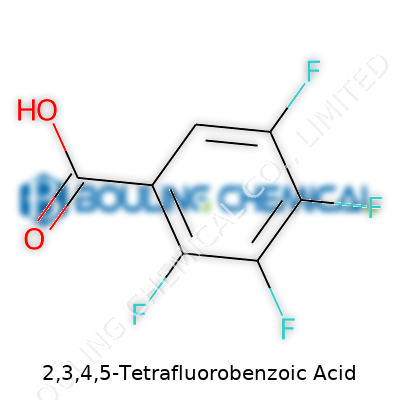
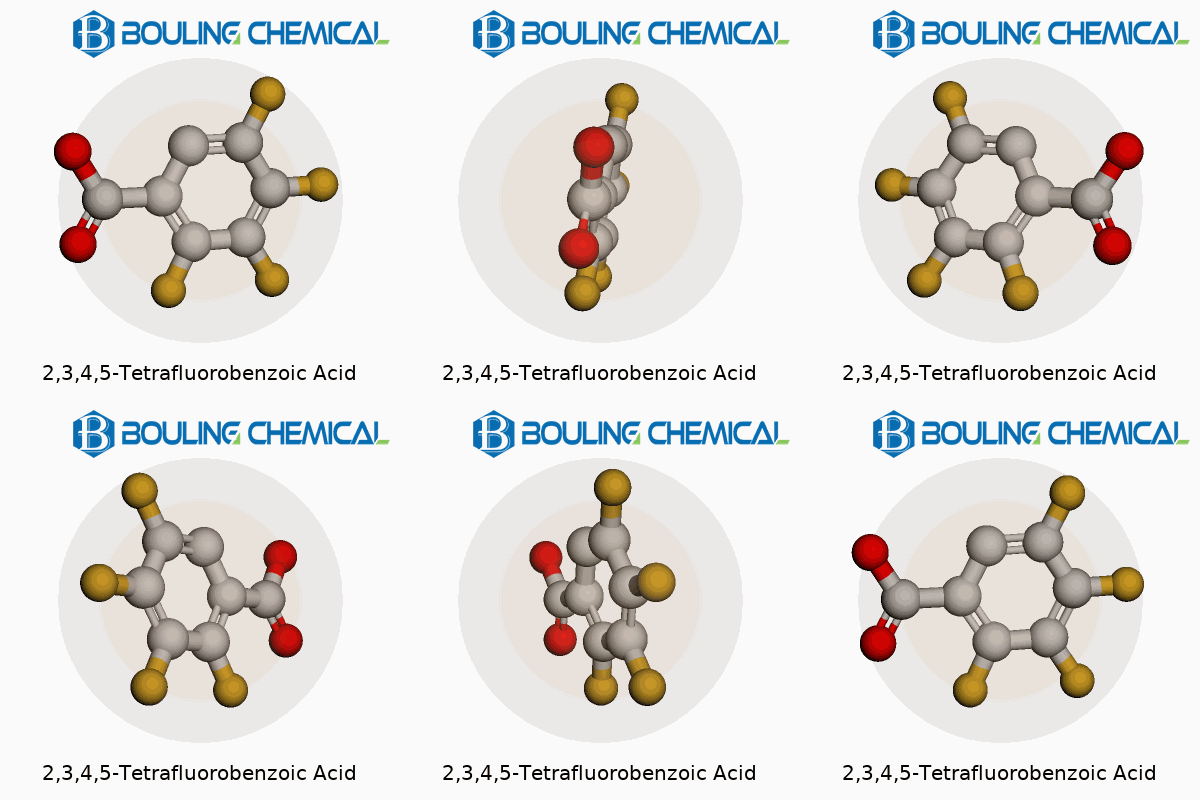
Digging into the details of 2,3,4,5-tetrafluorobenzoic acid shows how much chemistry can surprise you. Its chemical formula is C7H2F4O2. That might not look like much at first, but there's more going on in those atoms than you might guess from a quick glance. For folks who spent time wrestling with organic chemistry, it’s easy to see how the swapping of hydrogen atoms for fluorine around a benzene ring changes everything. Each fluorine shows up on the second, third, fourth, and fifth positions, making this compound special compared to simpler benzoic acids.
Fluorine earns its quirky reputation in science for good reason. Swapping in four fluorine atoms turns a plain benzoic acid into something with unusual reactivity and stability. Fluorine resists breakdown, thanks to its tight atomic grip. In my own experience handling these kinds of compounds, even a few added fluorines can shift a chemical from benign to stubbornly unreactive. Chemists often look for these kinds of changes when designing anything from pharmaceuticals to specialty polymers.
In modern chemistry labs, a few atoms change a world of possibilities. Take a basic benzoic acid–it’s easy to find, and breaks down in the environment without much fuss. Drop in fluorine, and you alter how it interacts with enzymes, environmental conditions, and other chemicals. That’s why 2,3,4,5-tetrafluorobenzoic acid gets extra attention. Smart researchers tap into its unique properties when searching for new drug candidates or high-performance materials. Fluorinated molecules like this one help create medicines that hang around longer in the body, making treatments more effective. They also show up in advanced polymers, coating everything from electronics to non-stick cookware.
Any time the word fluorine pops up, environmental questions aren’t far behind. People in lots of fields–from waste management to water safety–know that fluorinated compounds don’t break down easily. Some hang around in waterways and soils for decades, bringing health concerns nobody can afford to ignore. While 2,3,4,5-tetrafluorobenzoic acid isn’t in the same league as notorious perfluorinated compounds, the stubborn nature of these molecules raises fair questions.
Scientists wrestle with how to balance useful properties and risk. In my own lab days, the required safety training always included special disposal for anything with multiple fluorines. Finding solutions will probably come from two directions: designing safer, more biodegradable alternatives, and building better systems to detect and remove persistent chemicals before they escape into the wider world. History shows that chemistry moves fast, but responsibility needs to move just as quickly.
Knowing the formula C7H2F4O2 only scratches the surface. What matters most is how this knowledge shapes our next moves. Chemists, engineers, and policymakers carry a shared job here. They can push for greener synthesis routes and cleaner disposal methods. Regulators must keep pushing for transparency and more research funding to get a real handle on chemicals like 2,3,4,5-tetrafluorobenzoic acid. Community awareness and honest debate about costs, benefits, and consequences will drive the changes people want to see in the field.
Most folks outside chemistry circles haven’t heard of 2,3,4,5-tetrafluorobenzoic acid. To many, it just looks like a name on a lab supply catalog. Once you dig deeper, you see where this low-profile compound leaves its mark. In my own university days, I ran across it during a research internship—its presence kept popping up on whiteboards, especially in talks about designing new molecules for labs and industry.
Tetrafluorobenzoic acid isn’t just some molecule gathering dust. Chemists turn to it when they want to build more complex fluorinated materials. The reason is the trifecta of fluorine atoms, which bring unique properties. Take medicinal chemistry, for example. Adding fluorine changes how a molecule interacts inside the body: it can block some enzymes from breaking it down, or even help a drug reach particular tissues. You see this logic in new pharmaceuticals, especially where stability or metabolic resistance plays a part.
Even in crop protection, where every season brings new bugs and plant diseases, fluorinated building blocks help chemists piece together new pesticides. One former colleague tackled a project aiming to boost the effectiveness of a crop treatment while limiting runoff—they started with molecules much like tetrafluorobenzoic acid.
In my own graduate research, we experimented with 2,3,4,5-tetrafluorobenzoic acid to shape high-performance coatings. The compound’s structure let us tune how polymers handled heat or resisted harsh chemicals. This type of acid makes a difference in specialty plastics or films—a necessity in electronics, for folks running clean rooms or building components for solar panels and batteries.
These materials don’t just appear in science fiction labs. Laptops, LED displays, and even wind turbines use high-performance plastics made with fluorinated pieces. The acid becomes a quiet helper, offering backbone strength and resistance to oxidation.
Fluorinated chemicals like 2,3,4,5-tetrafluorobenzoic acid also let chemists design greener routes. For some reactions, you want a compound that resists degradation during a tricky step, or you might want to make a catalyst that sticks around longer. Some labs have been able to cut waste by swapping more reactive chemicals for stable acids like this one—which I always found to be a small but meaningful improvement.
Still, the fluorine atoms bring trade-offs. There’s real debate about persistence of some fluorinated compounds in the environment. While tetrafluorobenzoic acid doesn’t top the watch lists, its cousins show up as stubborn pollutants. It’s on chemists, regulators, and manufacturers to test thoroughly and design molecules that do their job without sticking around forever.
Applications for 2,3,4,5-tetrafluorobenzoic acid come from scientific creativity grounded by caution. Researchers eager to build the next drug or super-material find plenty of use for it. Just as important, the chemistry world keeps hunting for new ways to manage waste and close the loop. Focusing on responsible design means understanding not just how useful fluorinated compounds can be, but also where their limits show up—with eyes wide open to both promise and risk.
From my own late-night grinding in the lab, there’s nothing quite like trying to dissolve a new fluorinated benzoic acid for NMR and watching it stubbornly refuse to play along. 2,3,4,5-Tetrafluorobenzoic acid, with its four highly electronegative fluorines on the ring, brings some wild cards to the table. Its structure slashes electron density around the aromatic core and dramatically makes the carboxyl group tougher to ionize. That snowballs into unusual solubility quirks.
Water rarely wins with highly fluorinated aromatics. If a benzoic acid carries just one or two fluorines, you still get moderate water solubility. Quadruple that and water simply can’t break through the hydrophobic shield around the ring. The carboxylic acid bit tries, but unless you start forcing pH change, dissolving this in pure water just isn’t happening. My own efforts with concentrated solutions led only to tiny flecks swirling stubbornly at the bottom.
Ethanol and methanol offer a bit more hope—these alcohols walk the line between polar enough to nudge the acidic functional group and nonpolar enough to chat up that heavy aromatic region. I’ve managed to coax moderate amounts into methanol with some patience—warming slightly, always keeping an eye out for problems from exothermic mixing. Cosmic chemistry? No, just persistence and some trial-and-error.
Acetonitrile and dimethyl sulfoxide (DMSO) are classics for pushing the odds with tricky solutes. DMSO, with its wild ability to dissolve just about anything except polytetrafluoroethylene, does a reliable job on most fluorinated aromatics. In my experience, if you can’t get a clear solution of 2,3,4,5-tetrafluorobenzoic acid in DMSO, odds are you’re not stirring hard enough or there’s something off about your sample. Acetonitrile gives a surprisingly strong showing too, making it a favorite for analytical runs where you want to avoid DMSO’s smelly fingerprints.
People often assume solubility is a behind-the-scenes technicality, but much hangs on it. If a compound resists dissolving, even the best-planned synthesis, purification, or analysis stalls. We faced this in the lab when trying to use tetrafluorobenzoic acid derivatives in palladium-catalyzed couplings. Poor solubility meant incomplete reactions, fouled separations, wasted time, and strained nerves. It drove us right back to the solvent shelf, scouring for that magic sweet spot between “crystal clear solution” and “budget-friendly, non-toxic option.”
Researchers haven’t published tons of detailed solubility tables for this compound—a fact that trips up newcomers. Real-world data points to DMSO and hot ethanol as decent choices, with water all but absent, and common nonpolar solvents like hexane completely outgunned.
Trouble dissolving 2,3,4,5-tetrafluorobenzoic acid doesn’t mean dead ends. Sometimes, just a tiny pinch of base (try NaOH or K2CO3) can convert the acid to its salt form, which jumps into water much more willingly. If you need a non-polar environment, consider making an ester derivative—an old-school trick, but it spares you the all-day solvent search.
Bottom line: every chemist faces a “will it dissolve?” moment. Fluorinated benzoic acids like this one put your patience and problem-solving skills to the test. Learning to think through solubility is less about memorizing tables and more about understanding how structure and solvent shape your next experiment’s success—or failure.
People working in labs know the reality of handling specialty chemicals can make or break a long day. 2,3,4,5-Tetrafluorobenzoic Acid might sound fancy or obscure if you only know common household products. To professional chemists, though, it’s just another compound with its own quirks and risks. Storing it right isn’t just ticking a box for compliance or insurance. It keeps the sample safe, protects staff, and prevents hours of work from ending up in the waste bin—all things the textbooks sometimes overlook.
No matter which fluorinated aromatic acid you’re handling, it rarely shows up on safety posters in break rooms. Still, anyone with a few years working around chemicals has probably watched somebody rush a storage job, setting up an afternoon of headaches or worse. Keeping a pure sample of 2,3,4,5-Tetrafluorobenzoic Acid tucked away in the right place helps eliminate arguments about who contaminated what, and who’s picking up the overtime bill to remake it.
I’ve seen what happens if you treat chemicals with the same attitude you treat bulk salt in the back of a kitchen. Powder caking together, strange residues around the lid, nervous new hires whispering about odd smells. Even though this acid isn’t among the world’s most explosive or volatile, it brings enough unknowns that letting it sit near direct sunlight or in an open shelf just invites bad news. High humidity can clump powders or slowly change their characteristics. Sunlight sometimes messes with perishable organic molecules, speeding up decomposition without any dramatic warning sign.
Good habits in the lab start at the shelf. Cabinets labeled for acids earn respect for a reason. 2,3,4,5-Tetrafluorobenzoic Acid belongs with other organic acids—not near oxidizers, not sitting next to reactive bases or open containers. If you can control the temperature, go for cool and dry. A basic refrigerator not used for food cuts down risk from both heat and curious coworkers.
Don't rely on memory for labels. I’ve seen sharp people forget what’s what on a bad Monday morning. Permanent, legible, chemical-resistant labels spare the lab from awkward phone calls weeks later. The smallest, tightest cap on a brown glass bottle works better than a loose screw-top plastic jar. Tight closures keep moisture and air out, sparing both the sample and your nerves.
Ignoring the rules in chemical storage doesn’t usually catch up immediately. Problems hide out, waiting for a power outage or distracted end-of-shift. Compliance requirements for chemical storage stem from experience, not just bureaucracy. The Environmental Protection Agency and OSHA have published guidance rooted in accident investigation and toxicology. Chemicals like 2,3,4,5-Tetrafluorobenzoic Acid should never be stored with incompatible substances, and routine checks for signs of leaks or degraded containers need to become part of the daily rhythm.
Storing a compound right says you take your work and coworkers seriously. It’s not just about following orders. It’s about the peace of mind that comes from knowing—on a stormy night or quiet Saturday morning—the stockroom won’t hold any surprises that risk your health, the integrity of your research, or even the whole facility.
I’ve watched labs where everybody bought into safe storage practices. Accidents dropped. Samples lasted longer. Even the mood lifted once nobody had to stress about running out of a material because some unknown exposure spoiled it. Lock up the acids tight, label your containers, block out the sunlight, and share those lessons with newcomers. The real wins come from what never happens: no ruined samples, no safety incidents, nothing to clean up but your own glassware at the end of the day.
Some chemicals seem about as exciting as a parking lot, but they can surprise you. I remember my first year working with oddly named compounds, expecting them to be mild-mannered just because nobody warned me. One of those names that might slip through without a lot of fuss is 2,3,4,5-Tetrafluorobenzoic Acid. On paper, it’s a simple structure — a benzoic acid ring with four fluorines. In practice, dealing with it safely calls for paying attention from start to finish.
2,3,4,5-Tetrafluorobenzoic Acid shows up in research chemistry and pharmaceutical work. The fluorine atoms make it more reactive and boost its chances of getting into the air or onto your skin. Fluorinated compounds have a reputation for being just a bit sneakier than their non-fluorinated cousins. Some dissolve better in organic solvents, some stick around on surfaces longer. From a safety point of view, you have to treat even a “routine” benzoic acid derivative with care — especially with the four fluorines punching up its properties.
Most accidents never start with a dramatic spill. They creep up on you because you got used to skipping steps. With this acid, gloves and goggles aren’t optional. Nitrile or neoprene gloves block more fluorinated organics than latex. If you’ve had a rash pop up under latex, you already know what I mean. Eye protection catches the dust. Always work with enough ventilation. Even if the chemical’s vapor pressure is low, good airflow keeps low-level exposures from sneaking up on you.
I’ve seen benches coated with a ghostly white powder after someone forgot to clean up properly. That’s not just a paperwork headache. Small amounts on hands or workbenches can end up in places you don’t expect — especially right next to your lunch or on your phone. Double check your clean-up. The tiny bit of extra time makes labs safer for everyone. Label every container, even for overnight storage. Life moves fast; you will forget if you rely on memory alone.
All benzoic acids cause irritation, but swapping in fluorine atoms tends to ramp up their bite. Inhaled dust or skin contact often causes redness or itching. Chronic exposure brings worse news: respiratory symptoms or skin sensitization if you slip into bad habits. People sometimes ask if this stuff causes cancer or birth defects. The full research story hasn’t landed yet, so there’s no reason to tempt fate by being careless. That’s true for any synthetic organic with multiple halogens.
Fluorinated chemicals stick around. Down the sink or into the regular trash isn’t an option. Experts in chemical waste disposal will take care of it, but only if you help by labeling waste right and sealing it tight. Acid-resistant bottles work best, and logging what you toss makes sure it won’t mix badly with something else in the waste stream. Storage comes down to dry, cool, and out of the sun — pretty much what the safety data says, but it saves you from headaches later.
Getting comfortable with basic discipline protects both people and results in the lab. Fluorinated benzoic acids, as harmless as they might seem at first pass, deserve a spot on your mental checklist: gloves, goggles, clean bench, well-sealed waste. It’s not about being paranoid — it’s about not repeating the kind of simple mistake that catches up with even the most experienced folks at the worst moment. Paying attention each step of the way is worth it, no matter how routine the lab day feels.